





A record-height turbine in Germany is reaching for winds far above conventional towers, with its developer expecting significantly higher energy output from the same footprint.
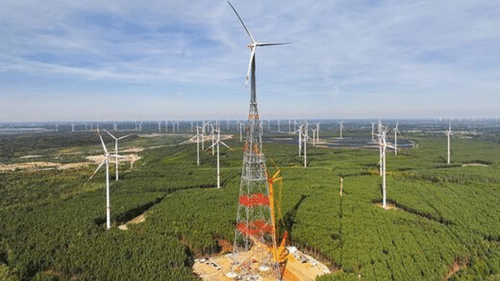
A wind turbine standing 365 metres tall has reached its full height in Schipkau, eastern Germany, creating what its developer GICON describes as the world’s tallest wind-energy installation. Its rotor hub sits 300 metres above the ground, placing the turbine in a layer of the atmosphere where winds are stronger and more consistent than those closer to the surface.
The project is designed to test whether simply taking a wind turbine higher can significantly increase the amount of electricity generated without requiring more land. GICON says the technology could produce about twice the energy of a conventional onshore turbine with the same rotor diameter, although that figure remains a developer projection that the pilot must demonstrate in operation.
Built in Lusatia, a former lignite-mining region, the turbine is being developed by Dresden-based GICON on behalf of Germany’s Federal Agency for Disruptive Innovation, known as SPRIND. The project builds on work associated with East German engineer Horst Bendix, who promoted the idea of using much greater tower heights to access stronger winds.
The unusual height required a different approach to construction. Rather than assembling a conventional tower that would need extremely tall cranes, GICON uses a telescoping lattice-tower design. The inner section of the tower was raised through the surrounding structure using a specialised lifting system before being locked into its final position. GICON says the structure contains more than 2000 tonnes of steel and about 22,000 individual components.
The completed installation has a 300-metre hub height and 365-metre total height. Its pilot turbine has a rated power of 3.8MW and uses a rotor with a diameter of about 126.2 metres. GICON previously estimated that the pilot should generate at least around18 GWh of electricity per year, equivalent to the annual electricity consumption of roughly 6000 households under the company’s calculation.
The turbine’s height is important because wind does not behave uniformly from the ground upwards. Buildings, trees, and terrain create turbulence and slow the air near the surface. As altitude increases, these effects become less significant, and wind speeds generally increase. GICON’s system is intended to exploit this difference by placing the rotor much higher than those of conventional onshore turbines.
The company says the pilot could generate roughly twice as much energy as a conventional turbine using the same rotor diameter. The comparison refers to energy generated over time, rather than doubling the turbine’s 3.8 MW rated power. Future versions of the GICON system are planned to use turbines with rated outputs above 7MW.
That distinction is important because the 365-metre structure is currently a demonstration of the technology rather than proof that every high-altitude turbine will produce twice as much electricity. The turbine still has to operate through different weather and wind conditions before the claimed energy advantage can be properly assessed.
GICON’s earlier project information also proposed much larger future systems. For high-altitude turbines using 8MW or larger turbines, the company has projected annual generation of around 30–33 GWh, depending on the site and wind conditions. These figures are forecasts rather than measured output from the current pilot.
The developers are particularly interested in using the technology at existing wind farms. GICON and SPRIND say high-altitude turbines could potentially be installed as a second generation level above existing wind turbines, allowing more electricity to be produced without opening completely new wind-farm sites. Their current assessment suggests Germany could potentially accommodate up to 4000 such towers, although this is a potential estimate rather than an announced construction programme.
The concept could also address locations where conventional onshore wind turbines struggle to produce enough electricity. GICON says stronger winds at 300 metres could make sites with relatively weak winds at conventional hub heights more useful for generation. The company is therefore positioning the technology not only as a taller turbine, but as a way of accessing an additional layer of the atmosphere for renewable-energy production.
The pilot is not yet a finished commercial system. GICON reached the record height on September 28, 2026, while final work and commissioning remain to be completed. Official operation is planned for November. The data collected after commissioning will be important in determining whether the structural complexity and cost of such tall turbines can be justified by their additional energy production.
India is already experimenting with taller wind-turbine structures, although at a much smaller scale. In June 2026, Suzlon launched its S175, a 5MW turbine with a 175-metre rotor and a 160-metre hybrid lattice tower. The design is intended to increase the viability of wind projects at sites where conventional turbine configurations may not deliver enough output.
The German project takes that same basic idea much further: instead of simply increasing tower height by several metres, it pushes the rotor to 300 metres above the ground. If the expected increase in energy generation is demonstrated in real-world operation, high-altitude wind could offer another way to increase renewable generation while making better use of existing wind-farm land.
For now, the 365-metre turbine is best viewed as a full-scale engineering experiment. Its record height has been achieved; the more important test will be how much additional electricity that height actually delivers.
For more information, click here.

