





The RP1 humanoid combines 160 Nm peak joint torque, in-house actuators, real-time motion control, and AI-based movement training for robotics development.
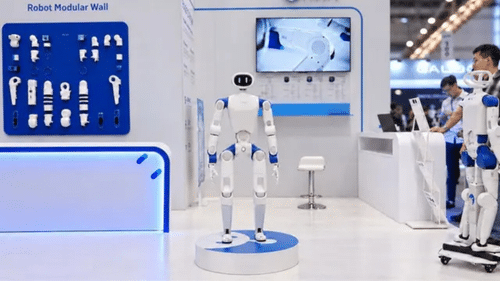
RoboParty has unveiled RP1 (ROBOTO 01), a bipedal humanoid robot designed as a development platform for robotics researchers, educators, and embodied AI teams. The robot combines in-house actuator modules, a real-time motion-control system, mechanical hardware, and AI-based control software to support dynamic movement and recovery from external disturbances. RoboParty publicly demonstrated RP1 at IROS 2026 on 28 September.
At the electronics and actuation level, RP1 is built around RoboParty’s Romomo actuator modules. The company states that the robot can deliver peak joint torque of up to 160 Nm, giving its joints the output required for dynamic movement and balance recovery. The actuator system works with the robot’s real-time motion-control architecture, allowing the control system to continuously adjust movement in response to changes in the robot’s state.
RoboParty demonstrated this capability through a “Kick Me” setup at IROS. Visitors were allowed to push or kick the robot, after which RP1 adjusted its posture and recovered its balance. The demonstration was intended to show the interaction between the robot’s mechanical structure, actuators, low-level control and higher-level movement algorithms rather than simply executing a predefined sequence.
The control system is supported by PartyOS, RoboParty’s development platform for humanoid robotics. It incorporates the company’s UFO framework, described as an unsupervised reinforcement-learning framework for humanoid control. UFO is designed to train low-level motion policies for behaviours including skill transitions, disturbance recovery, and fall recovery. This allows the robot to develop movement policies instead of depending entirely on fixed motion trajectories.
The approach links the physical and software layers of the robot. RoboParty is developing the robot body, actuator modules, low-level control and embodied AI algorithms as a coordinated system. This allows changes to the control algorithms to be evaluated directly on the physical robot, while the hardware provides a platform for testing and validating the resulting behaviours.
RP1 follows RoboParty’s earlier RPO (ROBOTO ORIGIN) humanoid platform. The company says RPO established its work in open-source bipedal robotics, while subsequent development of the Romomo actuators and RP Hand expanded the platform towards actuator technology, dexterous manipulation and human-robot interaction. These developments form part of the technical foundation behind RP1.
The company is positioning RP1 as a full-stack open robotics platform. Its planned development roadmap extends beyond mechanical files to include motion-control systems, simulation environments, software development kits, training tools and the PartyOS software foundation. The objective is to give developers access to different layers of a humanoid system, from hardware and low-level control to AI training and deployment.
RoboParty says RP1 is intended for applications including dynamic-motion research, embodied AI model training, validation and deployment, data collection, and continuous development. The platform is therefore designed less as a finished consumer robot and more as a hardware and software base on which researchers can develop and test new robotic behaviours.
The company plans to provide more details about the RP1 open-source roadmap in October 2026, followed by additional hardware and software releases and a planned mass-production programme later in the fourth quarter.
For electronics and robotics developers, RP1 is notable for bringing its actuation, real-time control and AI layers into a single development platform. Its 160 Nm peak joint torque and disturbance-recovery demonstrations indicate the hardware is being designed for dynamic operation, while the planned open development stack is intended to give researchers greater access to the underlying robotic system.
For more information, click here.

