

ISRO has validated Gaganyaan’s CM-SM separation system and confirmed critical capsule systems survived the test shocks.
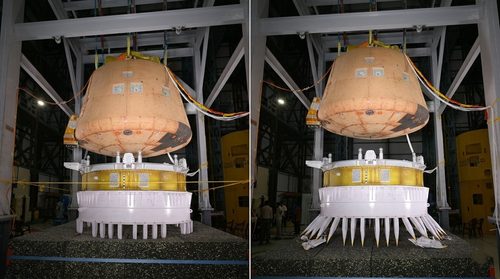
The Indian Space Research Organisation (ISRO) has completed a series of separation tests for its Gaganyaan human spaceflight programme at the Vikram Sarabhai Space Centre (VSSC) in Thiruvananthapuram. The tests simulated the separation of the Crew Module (CM) from the Service Module (SM), including the cutting of electrical and fluid connections linking the two sections. According to ISRO, the tests validated the separation system’s design and demonstrated that several critical Crew Module subsystems could withstand the associated mechanical shocks. The results support preparations for Gaganyaan’s first uncrewed mission, G1, which is targeted for launch in 2026.
Gaganyaan’s Orbital Module comprises the Crew Module, which houses the astronauts during flight and returns to Earth, and the Service Module, which provides propulsion and other support during the mission. The two sections remain connected from launch through the orbital phase, functioning as an integrated spacecraft. Before atmospheric re-entry, however, the Crew Module must separate from the Service Module and continue its journey towards Earth independently. The separation sequence is critical because the capsule must be released correctly to proceed with its planned re-entry and recovery operations.
The two modules are linked through umbilical connections that carry electrical and fluid services. Their separation therefore involves more than mechanically detaching two spacecraft sections. The connections must be severed in the correct sequence, and the release mechanism must move the modules apart without damaging equipment that remains inside the Crew Module. ISRO’s separation system uses precisely sequenced events involving pyrotechnic devices and jettisoning mechanisms. Pyrotechnic devices use controlled explosive charges to initiate specific actions, while the jettisoning system enables the modules to separate.
To evaluate the system, ISRO established a test setup at VSSC that reproduced the overall Crew Module–Service Module assembly. Engineers fitted the setup with extensive instrumentation to monitor the tests as the simulated separation sequence was carried out. The tests included severing several umbilical connections, recreating an important part of the process that the spacecraft must perform before re-entry. The ground trials were intended to validate the overall system design and establish whether sensitive equipment could tolerate the mechanical disturbances generated during separation. ISRO has not disclosed numerical shock measurements or the number of test runs in its announcement.
The subsystems assessed included avionics, inertial navigation systems and the Thermal Protection System covering the aft and conical heat shields. Avionics support spacecraft monitoring, control and other electronic functions, while inertial navigation systems help determine the vehicle’s orientation and motion. The heat shields form part of the protection needed to manage the intense thermal environment encountered during atmospheric re-entry. ISRO also reported checking the Crew Module Deployable Umbilical Shield, which protects the area associated with the module connections, and pyrotechnic devices used in the Crew Module Uprighting System and Thermal and Humidity Control System. The space agency said these critical subsystems demonstrated the required shock survivability during the tests.
The separation sequence is a standard feature of crewed spacecraft that discard a service section before returning to Earth. However, each spacecraft requires its own mechanisms, timing and qualification procedures. For Gaganyaan, the challenge is to ensure that the release sequence operates as designed while protecting the electronics and other systems needed for the capsule’s remaining flight and recovery stages. The latest tests provide evidence about the performance of the separation hardware under simulated conditions, but they do not replace the need to demonstrate the complete sequence during a flight.
The separation test is part of a broader programme of qualification and recovery-system checks leading up to G1. Earlier milestones reported during 2026 included tests associated with the Crew Module’s uprighting system and umbilical mechanisms. A Crew Module drop test has also been conducted to evaluate its parachute-based descent and recovery sequence. These activities address different phases of the mission, from maintaining spacecraft connections to ensuring that the capsule can return safely after its flight.
G1 is planned as an uncrewed test flight ahead of India’s first crewed Gaganyaan mission. The flight is expected to carry Vyommitra, a humanoid robot developed for the programme, rather than astronauts. ISRO Chairman V. Narayanan has indicated that the uncrewed mission is targeted for 2026, but the agency has not announced a confirmed launch date. The crewed mission has been targeted for 2027, although the schedule depends on the completion of the necessary development, qualification and flight-readiness activities.
For India’s electronics and aerospace industries, the tests highlight the demands placed on systems designed for human spaceflight. Avionics units, navigation electronics, sensor interfaces and control systems must continue functioning after exposure to mechanical loads that can occur during separation and other flight events. Qualification therefore involves not only verifying that individual circuits operate correctly, but also establishing that complete assemblies remain reliable in the environments for which they are designed.
Indian engineering companies and research institutions working on aerospace electronics can draw lessons from the need to integrate robust hardware, precise sequencing and extensive test instrumentation. However, ISRO’s announcement does not identify individual suppliers or provide detailed component-level performance figures. The results should therefore be viewed as a programme-level qualification milestone rather than evidence about any particular commercial component.
The successful ground tests mark another step towards Gaganyaan’s first uncrewed flight. The next major milestone will be demonstrating the spacecraft’s systems during the mission itself, as ISRO continues preparations for India’s human spaceflight programme.
For more information, click here.