

The latest runtime monitoring solution captures system anomalies with diagnostic traces, logs, and core dumps, helping developers identify intermittent faults and improve firmware reliability.
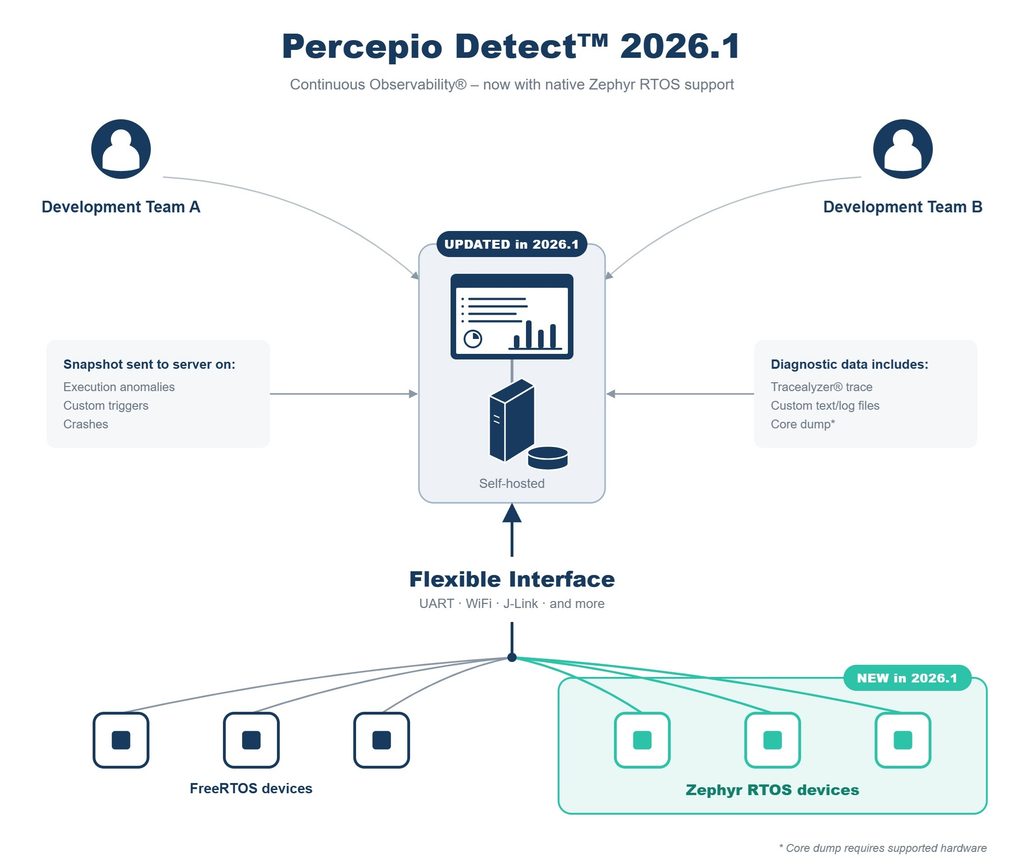
Percepio Detect 2026.1 by Percepio AB is a runtime observability solution from Percepio AB designed to help embedded developers detect, capture, and diagnose software anomalies in systems running Zephyr RTOS. It introduces native Zephyr support, enabling continuous monitoring on target hardware without requiring continuous trace streaming or repeated fault reproduction.
The software uses a security-camera-style monitoring approach to capture compact diagnostic snapshots when unexpected runtime behaviour occurs. These snapshots can include system traces, application logs, and optional core dumps, providing developers with the context needed to investigate faults and identify their root causes.
A key feature is its ability to detect abnormal system behaviour before it develops into a critical failure. Its TaskMonitor capability tracks CPU activity across individual threads, helping identify freezes, excessive execution times, overloads, and timing irregularities. This enables engineering teams to uncover issues that conventional testing may overlook, including intermittent performance degradation and near-miss watchdog resets.
The key features are:

- Native Zephyr RTOS integration.
- Compact, event-triggered diagnostic snapshots.
- Arm Cortex-M programmatic core dump triggering.
- Thread-level CPU activity monitoring.
- Integrated core dump inspection and trace analysis.
For post-mortem debugging, Detect supports core dump capture, including programmatically triggered dumps on Arm Cortex-M devices. Developers can use API calls to preserve the active function call stack and surrounding runtime context when non-fatal errors or warnings occur, without requiring a Zephyr fatal error.
Integration with Tracealyzer enables visual analysis of captured diagnostic snapshots, including kernel events, thread execution, and application logging. An integrated core dump viewer complements trace analysis by allowing developers to inspect call-stack information within Detect.
The software is intended for embedded development, continuous integration and testing (CI/CT), and firmware quality assurance. It helps teams monitor real-time operating system behaviour, investigate intermittent communication delays, and identify resource or timing issues before products reach deployment. Initial validation includes development boards from Nordic Semiconductor and STMicroelectronics.
As AI-assisted and agentic software development expands, runtime observability can also provide feedback on execution behaviour, performance, and resource utilisation that automated code-generation workflows may otherwise lack.
Percepio Detect 2026.1 is available now, with a self-service evaluation download and ready-to-run demonstration package. To know more, click here.