





India has mastered scale. The next frontier is depth: globally trusted chips, design, components, and technology.
As India marked its 80th Independence Day on August 15, 2026, electronics were once again central to everyday life. Smartphones, telecom networks and electronic systems support transportation, banking, healthcare, communications, industry and critical infrastructure. Yet inside many of these products, much of the technology that determines value lies deeper: semiconductors, displays, sensors, printed circuit boards (PCBs), advanced materials, manufacturing equipment, software, design and intellectual property.

India@80 therefore raises a useful question: after building manufacturing scale, how does India build technological depth? The direction is increasingly visible. Mobile-phone manufacturing has transformed, component localisation is accelerating, semiconductor projects are moving into commercial production, chip-design capability is expanding, and initiatives are reaching into critical materials and advanced packaging.
The next electronics journey is not simply about making more products. It is about how much technology, intellectual property, and value India creates inside them.
Scale has arrived
India’s electronics transformation over the past decade has been striking. Electronics production rose from approximately `1.90 trillion in FY 2014-15 to `13.11 trillion in FY 2025-26, while electronics exports increased from about `382.63 billion to `4.24 trillion (US$47.96 billion). The momentum has continued into FY 2026-27: electronic-goods exports reached US$26.66 billion during April-August 2026, up 39.4 per cent year on year.

Mobile phones illustrate the shift. Production increased from `189 billion in FY 2014-15 to approximately `6.27 trillion in FY 2025-26, while exports rose from `15.66 billion to about `2.60 trillion. Mobile phones moved from the 153rd-largest export item in FY 2014-15 to India’s largest individual export product in FY 2025-26.
India is now the world’s second-largest mobile-phone manufacturer. The electronics-manufacturing ecosystem supports nearly 2.5 million jobs, with women accounting for nearly 30 per cent of the workforce; the mobile-manufacturing ecosystem supports around 12 lakh direct and indirect jobs, with women comprising nearly 70 per cent of the direct workforce.
The next phase is also supported by the Mobile Phone Manufacturing Scheme, approved on July 15, 2026, with an outlay of `625 billion for FY 2026-27 to FY 2030-31. Incentives range from 2.25 per cent to 5 per cent on eligible sales, with an additional incentive of up to 1.5 per cent linked to domestic sourcing of key components and sub-assemblies. The emphasis is shifting from handset volume toward greater value creation within India.
Components: Where the value hides
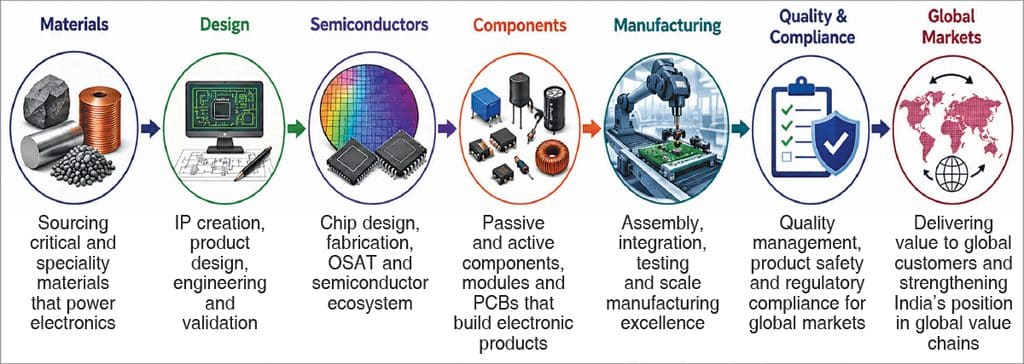
A sophisticated electronic product depends on a broad component ecosystem: semiconductor devices, PCBs, displays, camera modules, passive components, connectors, sensors, batteries and electromechanical parts. The same is true for automobiles, telecom equipment, medical devices, industrial controls and computing systems.
The Electronics Components Manufacturing Scheme (ECMS) is intended to push domestic manufacturing deeper into this value chain. The Union Budget 2026-27 raised the scheme’s outlay to `400 billion. The scheme covers display and camera-module sub-assemblies, multi-layer and advanced PCBs, passive and electromechanical components, lithium-ion cells for digital applications, optical transceivers and electronics-manufacturing capital goods. By August 2026, 106 applications had been approved, representing `695.48 billion in investment and about 74,600 direct jobs.
The inclusion of manufacturing equipment matters because a mature ecosystem must increasingly develop the machines, processes and production technologies required to make electronics. Deeper component capability can increase domestic value addition, shorten supply chains, improve resilience and create specialised engineering knowledge.
Critical materials: The hidden dependency
The localisation story extends upstream. Rare-earth permanent magnets are used in advanced electronics, electric vehicles, renewable-energy equipment, aerospace and defence applications. India’s dependence on imported high-performance magnets has therefore become an industrial and supply-chain issue.
The Scheme to Promote Manufacturing of Sintered Rare Earth Permanent Magnets, approved on November 26, 2025, with an outlay of `72.80 billion, targets 6000 metric tonnes per annum of integrated domestic manufacturing capacity, from rare-earth oxides to finished magnets.
The broader lesson is that electronics resilience depends on materials that may never appear in a finished-product label but can determine whether production continues during a disruption.
Chips: From approval to production
Semiconductors sit inside almost every modern electronic system, from smartphones and automobiles to medical equipment, telecom networks, industrial automation, satellites, defence systems, data centres and AI infrastructure.
India’s semiconductor story is now moving beyond approvals. As of September 2026, 12 semiconductor projects have been approved under Semicon 1.0 across six states, representing investment commitments exceeding `1.64 trillion. Five of those 12 projects had commenced commercial production, following the September 17 inauguration of additional commercial production lines at CDIL Semiconductor in Mohali and Suchi Semicon in Surat. This marks a visible shift from policy intent toward manufacturing.
The AI connection makes this more significant. AI infrastructure requires processors, memory, power electronics, networking, and high-performance computing, while AI is also influencing semiconductor design and manufacturing. India’s semiconductor and AI ambitions are increasingly part of one technological ecosystem.
Semicon 2.0: Beyond the fab
Approved on July 15, 2026, with an outlay of `1.27 trillion, Semicon 2.0 is organised around six pillars: design, semiconductor equipment and materials, fabrication facilities (fabs), advanced packaging, research and development, and talent.
A semiconductor facility cannot operate in isolation; it depends on specialised equipment, chemicals, gases, substrates, packaging, testing, design tools, intellectual property and skilled engineers. Long-term success will therefore depend not only on fabs, but on the surrounding ecosystem.
India already has a substantial semiconductor engineering and design talent base. The next opportunity is to translate more of that capability into India-owned intellectual property and commercial products: fabless companies, product start-ups, systems-on-chip, patents and technologies originating in India. Partnerships with multinational companies remain important for technology access, investment and global markets. The objective is to increase the share of innovation that is originated, owned and commercialised from India.
Advanced packaging is another emerging frontier. In August 2026, the Centre for Materials for Electronics Technology (C-MET) Pune invited Indian industry participation in developing advanced photonics packaging technologies using additive manufacturing for photonic integrated circuits. As computing becomes more powerful, packaging and interconnect technologies are increasingly important for moving data efficiently between chips and systems, including AI data-centre interconnects.
India’s semiconductor opportunity therefore extends beyond making chips to designing, packaging, connecting, testing and integrating them into sophisticated systems.
Self-reliance without isolation
Technological self-reliance should not mean reproducing every part of a global value chain domestically. A sophisticated electronic product may contain intellectual property from one country, wafers fabricated in another, packaging elsewhere, materials from several regions and software developed across multiple locations.
A stronger definition is the ability to participate in global technology networks from a position of capability rather than excessive dependence. That requires domestic strength in strategically important technologies, competitive Indian suppliers, multiple supply options, international partnerships, engineering capability and resilient supply chains.
Bharat Mandapam and Yashobhoomi in New Delhi increasingly provide platforms where global industry, technology, innovation and investment converge. SEMICON India 2026 was held from September 17 to 19 at Yashobhoomi, bringing together the global semiconductor ecosystem. The event underscored the transition from semiconductor ambition to a broader silicon-to-systems ecosystem.
Self-reliance and global integration are therefore not opposites. A technologically stronger India can become a more valuable participant in global electronics supply chains.
Can quality keep pace with scale?
Production figures make headlines; reliability determines whether customers return. Defective components can stop assembly lines, weak process control can create large-scale failures, and poor traceability can turn a contained defect into an expensive recall.
As Indian electronics manufacturing expands, quality infrastructure must expand with it. Supplier quality, component qualification, reliability testing, failure analysis, process control, calibration, product safety, traceability and corrective-action systems become increasingly important, particularly for suppliers entering multinational supply chains.
Competitiveness will depend not only on price, but on consistent performance, reliable data, traceable processes and evidence that problems can be identified and corrected. For Indian electronics suppliers, quality is not merely a factory function; it is market access.
Compliance becomes competitiveness
The same principle applies to environmental and regulatory compliance. As Indian electronics exports expand, products encounter requirements such as the European Union’s Restriction of Hazardous Substances (RoHS) and Registration, Evaluation, Authorisation and Restriction of Chemicals (REACH), persistent organic pollutants controls, Per- and polyfluoroalkyl substances (PFAS) requirements, battery and packaging rules, responsible-minerals reporting, ecodesign, repairability, supply-chain due diligence, and Digital Product Passports, depending on the product and market.
These requirements reach into engineering and supplier management. A material selected during design can determine chemical compliance; supplier declarations can determine whether compliance can be demonstrated; and substance, component and circularity data can trigger reporting or market-access requirements.
Compliance therefore cannot be treated as paperwork after manufacturing. For globally ambitious Indian electronics companies, material, component, supplier and regulatory-data systems increasingly need to be built into product development from the beginning.
Sustainability starts on the drawing board
Growth also creates resource and end-of-life challenges. More electronics means greater demand for materials and energy, while major markets increasingly regulate products across their lifecycle.
Engineers are consequently being asked whether devices can be repaired, components replaced, materials recovered, hazardous substances controlled, and recycled content incorporated without compromising reliability. Product information must also support reuse and recycling.
These are increasingly engineering questions. Because India’s manufacturing capacity and product-development systems are still expanding, newer facilities can integrate quality, environmental compliance, traceability, and circularity early rather than retrofitting them later.
| From scale to technological depth | |
| Growing Strength Today | Opportunity For Tomorrow |
| Final-product manufacturing | Deeper component manufacturing |
| Mobile-phone scale | Broader electronics categories |
| Assembly | Higher domestic value addition |
| Component localisation | Critical-material resilience |
| Semiconductor investment | Complete semiconductor ecosystem |
| Chip production | Advanced packaging and integration |
| Engineering talent | Indian design and intellectual property |
| Export growth | Deeper global value-chain participation |
| Manufacturing scale | World-class quality and reliability |
| Regulatory compliance | Compliance by design |
| E-waste management | Circular product design |
People create technological depth
Factories create capacity; people turn capacity into capability. A deeper electronics ecosystem needs semiconductor and system designers, process and equipment engineers, packaging and photonics specialists, materials scientists, embedded-system developers, reliability experts and advanced-manufacturing technicians, alongside quality, regulatory, data and supply-chain professionals.
The next objective is not simply more jobs, but greater technological depth: experienced engineers, specialist suppliers, research institutions, design companies, testing laboratories and accumulated manufacturing knowledge.
MSMEs: small firms, big difference
Large fabs and smartphone factories attract headlines, but mature electronics ecosystems depend on specialised smaller companies. Indian Micro, Small, and Medium Enterprises (MSMEs) have opportunities in components, precision manufacturing, tooling, equipment, materials, testing, embedded software, product design and engineering services.
Their integration into international supply chains will be an important measure of progress. At the Department of Commerce’s Chintan Shivir on July 10, 2026, government and industry representatives discussed a roadmap towards US$150 billion in electronics exports by 2030, alongside stronger global value-chain participation and supply-chain resilience.
Reaching that ambition requires competitiveness across technology, cost, quality, reliability, compliance, logistics, and innovation. No single incentive can provide all of these. They require an ecosystem.
From scale to technological depth
India’s next electronics transformation can be viewed as a set of transitions as shown in the table above.
Together, these shifts offer a more meaningful definition of electronics self-reliance. It is not simply the absence of imports; it is the presence of capabilities.
What should India@100 measure?
As India marked its 80th Independence Day on August 15, 2026, there was much to celebrate. Electronics production has multiplied, exports have accelerated, mobile manufacturing has transformed, component localisation is gathering momentum, and semiconductor projects have moved from approvals into commercial production.
Yet scale alone will not define the next phase. By India@100, progress should also be measured by the chips India designs, the components and critical technologies it develops, the intellectual property it owns, the engineers and enterprises it nurtures, the resilience of its supply chains, and the quality and reliability Indian products demonstrate in global markets. The journey from ‘Made in India’ to ‘Designed and engineered in India, trusted worldwide’ may ultimately provide the clearest measure of technological self-reliance.
Neeta Verma is an environmental compliance leader with 27+ years in the global electronics industry, specialising in regulatory strategy and product stewardship, and has been published in Quality Magazine, Industry Today and Maintenance World.


