What happens once a navigation satellite leaves the launch pad? The journey holds another crucial step for India’s efforts to strengthen its indigenous navigation capabilities.
The Indian Space Research Organisation (ISRO) has completed its first orbit-raising manoeuvre for their NVS-03 satellite to help boost the system.

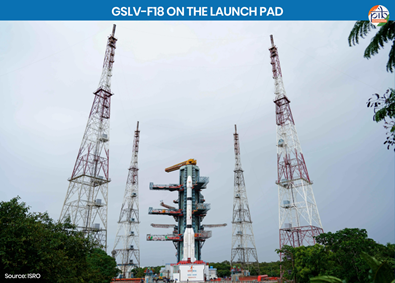
In our previous coverage, ISRO had announced that the NVS-03 was scheduled to be launched via the GSLV-F18 on 30th October 2026. The mission has now successfully completed and the launch vehicle placed the satellite into the Geosynchronous Transfer Orbit (GTO) at 11.51pm IST from the Satish Dhawan Space Centre in Sriharikota.
The NVS-03 is the third satellite in the second generation NavIC system. This aims to increase the performance, accuracy and reliability of navigation services within India. The navigation payload covers L1/L5/S-band signals. An indigenous atomic clock has been used to improve the timing accuracy.
A Liquid Apogee Motor (LAM) has been used to raise the orbit of the satellite. The satellite was placed within an elliptical orbit (GTO). A burn of the LAM occurred at the apogee of the orbit to increase the perigee of the satellite, allowing it to reach a circular geosynchronous orbit. ISRO have stated they have completed the first manoeuvre and the satellite is healthy.
Prime Minister Narendra Modi commented, “This mission marks an important step in strengthening NavIC, our indigenous satellite navigation system. Equipped with enhanced capabilities, NVS-03 will further our pursuit of self-reliance in critical technologies and support navigation services that benefit our people.”
The GSLV-F18 mission marks the 20th flight of the Geosynchronous Satellite Launch Vehicle for India. Once in its correct orbital position the NVS-03 will assist with NavIC services.