




Why just run isolated models? Edge agents fuse local sensors and logic to directly control machinery.
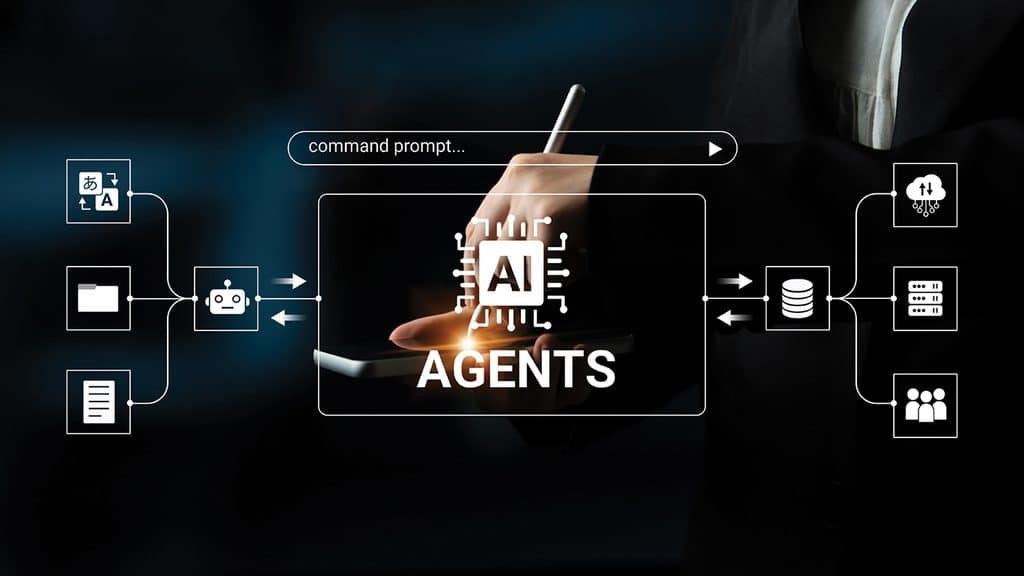
A vision model on a factory line spots a scratch on a part and flags it. That is where most Edge AI systems stop today—a single model, a single output, handed off to a person or another system to act on. Now picture the same camera doing more: checking whether the machine that produced the part is running within tolerance, comparing that reading against the last ten cycles, confirming no safety interlock is open, and only then deciding whether to pause the line, alert an operator, or simply log the event and carry on.

That second scenario is not a bigger model running the same job. It is a different kind of edge device—one that senses, weighs local context, and decides what should happen next, rather than only reporting what it sees.
This is the shift industrial Edge AI is beginning to make, and it changes what ‘readiness’ means for every engineer building on it. A trained model still needs a platform that can run it reliably. What is new is what that platform is asked to do next.
When inference is no longer enough
A model that only classifies or detects is doing inference: an input, an output, nothing else. That has been enough for years of Edge AI deployment—a camera flags a defect, a vibration sensor flags an anomaly, an operator decides what happens next. But as more decisions move to the edge, purely reactive inference starts to look incomplete. A vibration reading on its own does not say whether a machine needs immediate shutdown or can safely run to the end of a shift; that judgement depends on the machine’s recent history, its maintenance schedule, and what else is happening on the line right now.

A device that can only report what it sees, without weighing it against machine state, recent history, or safety conditions, pushes all of that judgement back onto a human or a separate system—the same round trip that made cloud-only architectures too slow for real-time industrial use in the first place.
Inference meets agency
The next step is not a smarter model. It is giving the edge device enough local context and logic to decide, not just detect, and enough restraint to know when a decision should still go to a person.
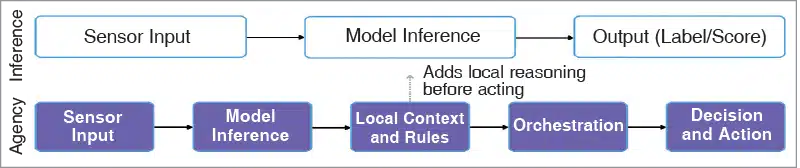
Traditional Edge AI follows a simple pattern: a trained model processes an input and produces an output—a classification, a bounding box, an anomaly score. What happens with that output is somebody else’s problem.
An edge AI agent changes that pattern. It still runs inference, but it combines the model’s output with local context: the current state of the machine, recent sensor history, applicable safety rules, and the step in the workflow that should follow. Instead of producing a label, it produces a decision—pause, escalate, adjust, or carry on. The model becomes one input to the agent’s reasoning, not the entire system.
This is a small conceptual shift with a large engineering consequence. A model can be validated in isolation, against a test set. An agent has to be validated as a system, because its behaviour depends on everything feeding into its decision—sensor quality, rule logic, timing—not just the accuracy of the model sitting inside it.
Why the decision must stay local
Some of this reasoning could run in the cloud. In practice, industrial environments rarely allow it. A safety-critical decision cannot wait for a network round trip measured in hundreds of milliseconds, and a factory floor with intermittent connectivity cannot depend on that round trip being available exactly when it matters. Sensor and video data are often too large, too continuous, or too sensitive to stream out for every decision. A robot arm or a conveyor safety system needs to keep making sound decisions even when the network briefly drops, not pause and wait for it to come back.
Bandwidth adds a second constraint that is easy to underestimate. A single industrial camera running continuous inspection can generate more data in a shift than is practical to backhaul to a cloud service, let alone process it within a useful time window. Keeping the decision local is often less about intelligence and more about simple physics—how much data can move, how fast, and how reliably.
None of this is new to industrial engineering—real-time control has always lived close to the machine, for exactly these reasons. What is new is asking that same local layer to also host reasoning and orchestration, not just fixed control loops, which raises the bar for what the platform underneath it needs to support.
Inside the agent stack