

A battery-powered implantable device combines ultrasound and controlled drug release to help deliver drugs deeper into brain tissue.
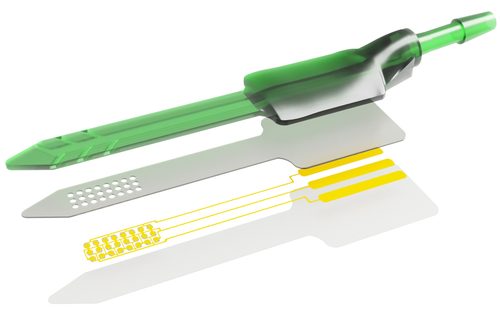
Massachusetts Institute of Technology (MIT) researchers have developed an implantable drug-delivery device that could help prevent the recurrence of glioblastoma, an aggressive type of tumour. The device consists of a reservoir that can release drugs over an extended period. It also uses ultrasound transducers that use sound waves to help drugs spread farther through the brain. The device could be implanted in the brain during surgery. It would gradually release drugs inside the brain to help kill the remaining tumour cells. After implantation, a wireless controller can be used to programme the exact dosages to be delivered, which increases the reach of the delivered therapy.
The device’s reservoir carries about 100 microliters of fluid, and a passive osmotic pump can be used for infusion. The ultrasound can be controlled wirelessly through Bluetooth. The device works on a small battery that can be recharged wirelessly.
For testing, a “tissue phantom”, which is a gel-like material engineered to mimic human tissue, is used. The tests reveal that the ultrasound-aided delivery spreads drug molecules much farther than when the drugs are delivered without ultrasound. The testing was also performed on mice, and the device was used to help deliver a substance called an MRI contrast agent into their brains.
If developed commercially for use in patients, the drug cannula and ultrasound array would be implanted inside the skull, while the other part of the device, including the battery and other electronics, could sit outside the skull. This technology could also be used to deliver immunotherapies or nucleic acids, including gene therapies. It also has the potential to be used in organs other than the brain.
“We started with the brain as a follow-up to our ImPULS technology, but eventually this can be used for other soft tissue treatments for different types of drugs, different types of interventions in deep body tissue,” says Canan Dagdeviren, an associate professor of media arts and sciences at MIT and the senior author of the study. “We are showing that we can make any kind of payload be distributed in a better way.”