

The BeagleConnect QuadESC combines four brushless motor-control channels, an Arm Cortex-M33 processor and a neural-network accelerator for robotics and drone applications.
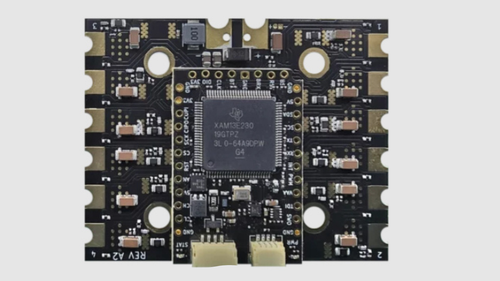
BeagleBoard.org has introduced the BeagleConnect QuadESC, an open-hardware motor-control board designed to operate four brushless DC (BLDC) motors. Measuring 60 × 48mm, the board integrates four three-phase power stages with the BeagleConnect Torque controller module, which uses a 200MHz Arm Cortex-M33 processor with dedicated mathematical and neural-network acceleration. It targets robotics, drone propulsion and real-time motor-control development, with editable hardware designs and firmware available for developers to inspect and modify.
The installed BeagleConnect Torque module is based on Texas Instruments’ AM13E23019 microcontroller, with 512KB flash and 128KB SRAM. Its trigonometric maths unit supports motor-control calculations, while the TinyEngine neural-network accelerator provides hardware support for application-specific inference, including potential fault and anomaly detection. The module also provides CAN connectivity through a TCAN844 transceiver, allowing the board to communicate with other components in a control system.
Each of the four motor channels uses a TI DRV8323SRTAR three-phase gate driver and three half-bridge power devices. The board provides dedicated pulse-width modulation (PWM) timing for each motor, alongside current and phase-voltage sensing. Twelve low-side current-sensing signals and twelve phase-voltage measurements support monitoring across the four motors. Three 12-bit analogue-to-digital converters handle current measurements, with the firmware coordinating sampling across the channels. Four temperature sensors monitor the power stages, while an additional measurement tracks battery voltage.
The board accepts battery inputs from 9V to 25.2V, corresponding to three-cell to six-cell battery configurations. Its current design targets are 40A continuous and 70A burst per motor, although these figures remain subject to thermal validation and should not be treated as established operating ratings. Connections include motor and battery solder terminals, an eight-pin flight-controller interface for commands and telemetry, and access to programming and debugging interfaces.
The open-hardware project provides editable KiCad designs for the mainboard and controller module, schematics, firmware sources and detailed hardware manuals through the project’s GitHub repository. Developers can use these resources to study the circuit design, develop custom motor-control firmware and adapt the hardware to specific robotics applications. Field-oriented control, DShot decoding, telemetry and AI-based diagnostics depend on the application firmware installed; they are not automatically available simply by powering the board.
For more information, click here.