

Can an AI copilot help hardware engineers save time, boost productivity, and catch circuit design mistakes before the hardware is built? Read on to find the answer.
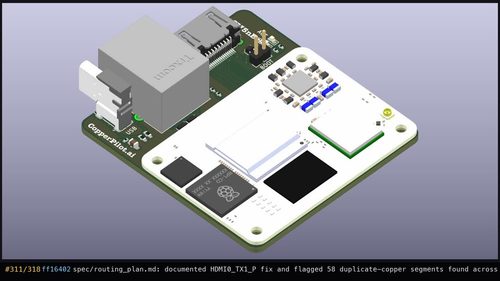
AI tools can generate circuit designs, but checking whether those designs are electrically correct remains an important part of hardware development. Indian startup CopperPilot has developed an AI copilot that can validate schematics, evaluate placement and routing decisions, and identify potential errors, with the option to correct them within existing design software.
Let us understand this with an example. You want to establish serial communication between two devices, for which you need to connect the receiver pin of one device to the transmitter pin of the other and vice versa. But what if you miss doing that? Such errors can occur even during professional hardware development. The AI copilot can identify this error in seconds. It can check circuit connections, evaluate placement and routing decisions, and identify potential errors in hardware designs.

Traditionally, tasks that engineers performed manually by reading spreadsheets or documents can now be done by this AI copilot. In a recent conversation, Aditya N G, co-founder and CEO of CopperPilot, revealed that with CopperPilot, hardware engineers can provide 10–20 PCB designs to the agent and ask it to estimate their power requirements and check whether they fit within the power constraints of, for example, an electric vehicle with multiple submodules.
The AI agent can identify when a mistake has been made and correct it within the design software. You can also ask it to stop and make the correction yourself if you have a different approach. “CopperPilot integrates with existing design tools and can step into different stages of the hardware engineering workflow. For example, you can ask it to validate electrical rule checks (ERCs) and verify whether a schematic is correct,” said Aditya.
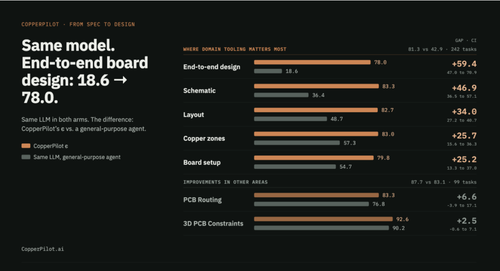
When tasked with designing a complete printed circuit board (PCB) from a prompt, a general-purpose AI agent scored about 18.6%, while CopperPilot scored about 78% on the same type of end-to-end design task. “Every day, the task is to make sure that the design agent is actually getting better at design,” added Aditya.
The tool aims to reduce the manual effort involved in reading datasheets, checking circuit connections, and validating hardware designs, allowing engineers to focus more on system architecture and product development.