

Titanium engineering boosts thin-film thermoelectric performance by 250 times, offering new possibilities for efficient energy harvesting, waste-heat recovery and compact power generation in electronic devices.

Researchers from Tohoku University, namely, Junya Kurahashi, Yi Shuang and Yuji Sutou, have successfully fabricated titanium-doped chromium nitride thin films that exhibit a 250 times higher thermoelectric power factor than pure chromium nitride. The new material is capable of enabling thermoelectric generation of waste heat energy in small electronic devices without the need for high temperature processing steps.
Materials that employ the Seebeck effect to generate electricity from temperature gradients are called thermoelectric materials. These materials are suitable for recovering waste heat produced in electronic devices, industrial machinery, and cars. Thermoelectric thin-film materials are especially promising for the development of integrated electronic devices. Unfortunately, most thermoelectric materials have to be prepared at high temperatures or on special substrates; thus, their use in sensitive heat devices is limited.
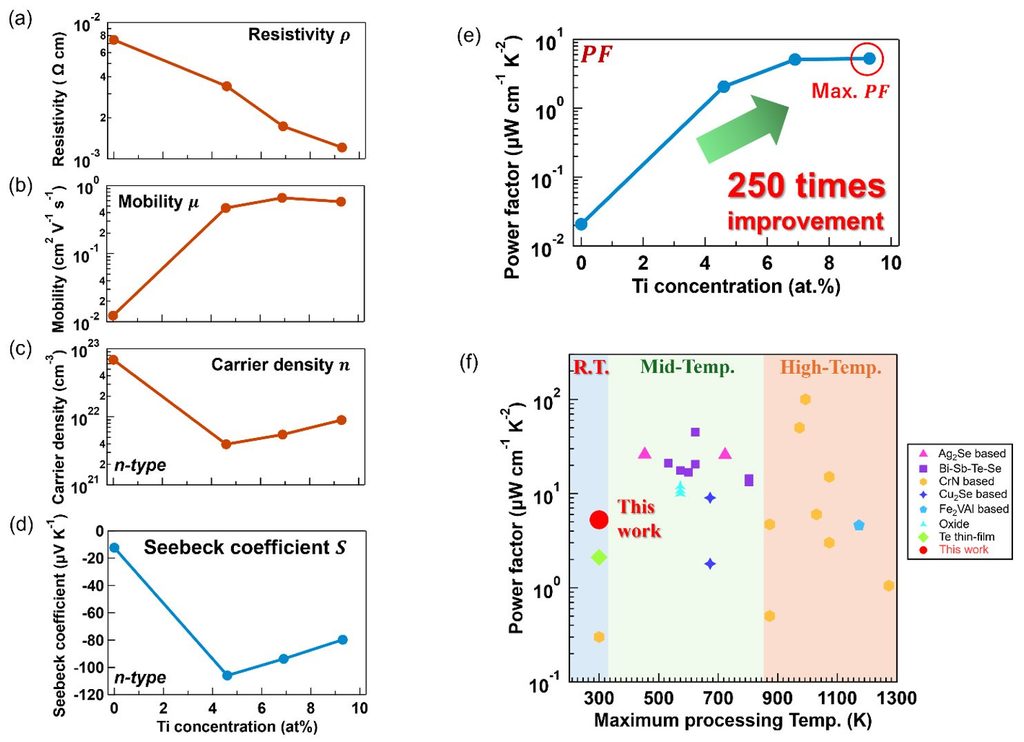
Chromium nitride is one of such promising materials that could be deposited in a thin film form at room temperature. However, conventional CrN films contain nitrogen vacancies that adversely affect their electric properties and decrease the efficiency of thermoelectrics. To solve this problem, the researchers have used titanium (Ti) that binds nitrogen atoms more efficiently than chromium.
The researchers used reactive sputtering technique to control titanium concentrations within 4.6 to 9.3 atomic percent, resulting in lower carrier concentration but significantly higher electron mobility by a factor of 100. The technique also resolved the problem of the usual compromise between electrical conductivity and the Seebeck coefficient that defines the voltage generated under temperature difference.
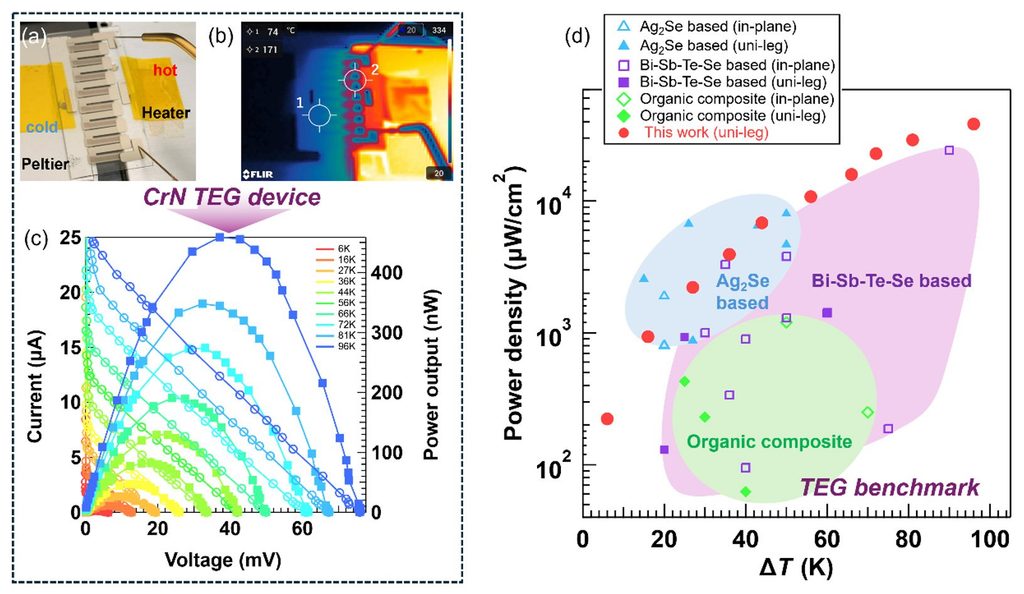
As a result, the doped film of titanium chromium nitride exhibited the power factor of 5.26 µW cm⁻¹ K⁻², more than 250 times higher compared to chromium nitride without any doping. The prototype generator built on the glass substrate demonstrated the maximum power of 455.8 nW at a temperature difference of 96 K, having the power density equal to 38.0 mW cm⁻², which is similar to the power density of already developed advanced thermoelectric materials with high-temperature manufacturing process.
The advance makes possible to use thermoelectric generators on flexible substrates, heat-sensitive electronics and micro-devices. Applications can include energy recovery from waste heat of electronic devices, industrial equipment and vehicle parts to generate additional power.