

A 5-micrometer gallium nitride micro-LED achieves 2.75 GHz optical modulation bandwidth at 25 mW, offering a low-power alternative for short-range data centre optical communication links.
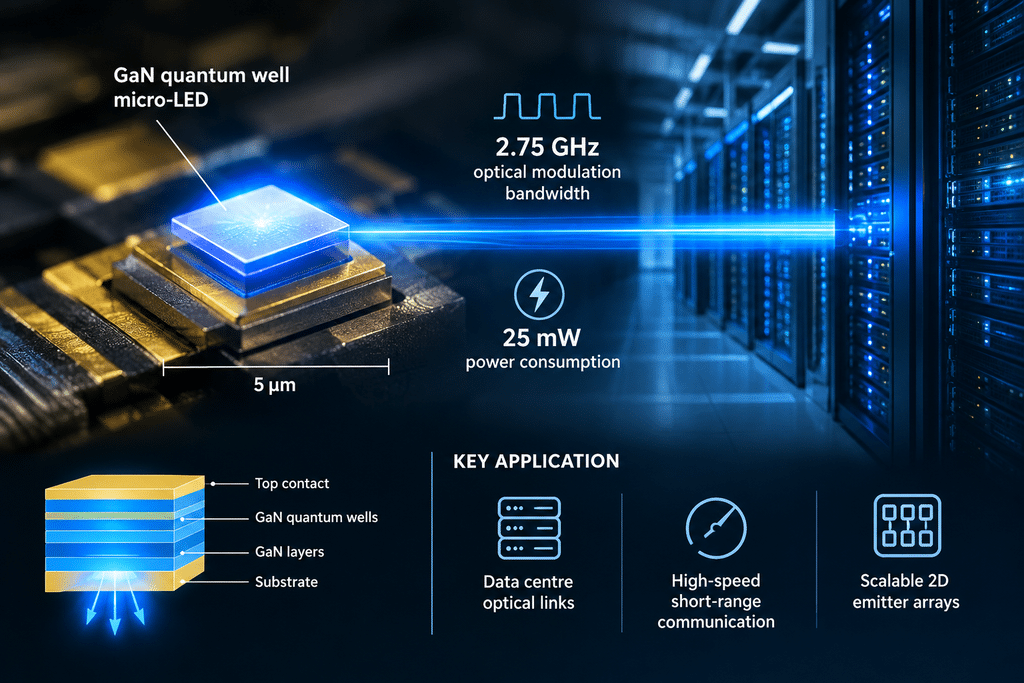
A 2.75 GHz optical modulation bandwidth GaN Quantum Well Micro-LED that consumes 25 mW of electrical power has been fabricated by scientists at the University of Illinois Urbana-Champaign and University of Notre Dame. The 5 micrometer device is the fastest quantum well LED to date and shows the promise of these devices for energy-efficient optical interconnects in data centers.
The technology is aimed at short range data transmission applications where the existing electrical interconnects have issues with bandwidth and signal loss and laser-based optical interconnects need more power and create heat. LED based optical interconnects can be used as an energy-saving solution for such interconnects especially for distances up to 10 meters which cover about 90% of data center transmissions.
This study investigates the relationship between the dimensions of a device and its optical modulation bandwidth as well as the power consumed by it. The dimensions of micro-LEDs were reduced from 100 micrometers to 2 micrometers to investigate the relationship between dimensions of devices, their bandwidth, and their switching energy requirements.
The results revealed that reducing dimensions does not necessarily increase efficiency. In fact, the dimensions of 5 micrometers gave the best trade-off between the bandwidth and power requirements. This bandwidth is the maximum speed at which the micro-LED switches from one state to another without significantly decreasing its illumination.
However, there are constraints that limit this speed of switching. The optimum design of the materials used in the fabrication of micro-LED and its electrical parameters is important to reduce parasitic effects.
Apart from the available bandwidth, the small physical size allows the possibility of incorporating several emitting devices into two-dimensional arrays where each LED is capable of sending an independent data signal. This could contribute to the implementation of dense optical communication systems for use within data centers. The study was done by electrical and computer engineering groups at both institutions, and some of the people who worked on the project include: Can Bayram, Peter Dragic, Milton Feng and Patrick Fay.