





A 16-joint robotic hand learns to manipulate different objects through simulation-based training without human demonstrations.
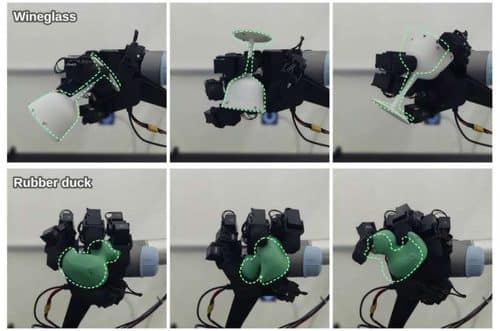
Researchers at the University of California, Berkeley and Davis have trained a robotic hand to move an object with just one hand. They taught the robot hand how to shift an object between its fingers while keeping hold of it, rather than simply picking it up and holding it still. They have also developed an additional software system that helps prevent the robot from dropping objects.

During testing, the robot was asked to perform 1,200 movement sequences. Without the safety system, it dropped objects 16 times. With the system, the number of drops fell to just four. The trade-off was that the robot sometimes failed to complete a few of the movements it was asked to perform.
The research team claims to have trained a 16-joint LEAP robotic hand using only simulation and without any human demonstrations. The researchers trained the robotic hand to move and rotate objects between its fingers, just as a human hand does. The training started with hundreds of thousands of computer-generated examples of how to grasp objects. Initially, the robot fingers had high friction, but as the model’s performance improved, the assistance was gradually reduced, and the hand was able to approximate more realistic conditions. The team also measured a real hand’s motor behaviour and incorporated it into the simulation.
The researchers tested their system using a real light bulb and plastic objects made using a 3D printer. These objects included a knife, a wine glass and a duck. Each object needed a different controller to handle it because they had different shapes and handling requirements. The researchers also developed a separate safety system. Its job was to check the controller’s planned movements and make small changes when needed to prevent the object from falling. It tried to keep the original movement as unchanged as possible while making it safer.
The evaluation was carried out using 4,800 requests involving movements of the four objects in six wrist orientations. The hand was reset if an object fell or became stuck. The robotic hand reached 95.2% of its targets without the safeguard and 91.5% with the safeguard. The system can manipulate objects while balancing task completion and grip security, but it still needs to become more reliable and learn to handle a wider range of objects.