




A miniature antenna uses a special plastic material and hollow structure to reduce signal energy losses.
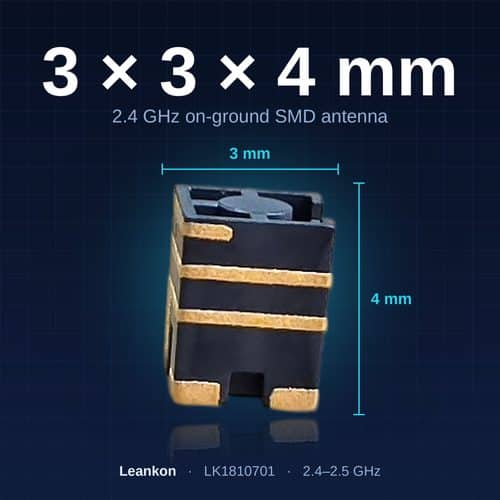
Leankon has launched LK1810701, a miniature 2.4GHz on-ground Surface Mount Device (SMD) antenna. The antenna can be mounted directly on a circuit board (PCB), even above the board’s ground plane. It does not need a traditional clearance keep-out zone and uses a manufacturing technique known as 3D Laser Direct Structuring (LDS) to create antenna structures in a small space.

The miniature 2.4GHz on-ground SMD antenna comes in a form that can be directly placed on a circuit board using automated machines. This helps achieve a high production rate, reduced manufacturing costs and consistent wireless (RF) performance, even when making large quantities.
In conventional antennas like monopole or loop configurations, ground keep-out regions are required to establish resonance and maintain acceptable radiation efficiency. For space-constrained applications, every millimetre of PCB area is critical. Hence, the ground clearance requirements become a significant design bottleneck. The new SMD antenna uses a special 3D spiral-shaped design that allows it to work properly when placed directly above the circuit board’s ground plane.
The company claims to use a process called Laser Direct Structuring (LDS). A laser creates very precise patterns on a special plastic material. These patterns are then made conductive to form a spiral-shaped antenna. It also uses a material with a high dielectric constant, known as high-Dk. This high-Dk material helps the antenna operate at the needed frequency even when the antenna is made small.

Small antennas can lose some of the signal energy as heat when radio signals pass through their materials. This reduces antenna efficiency. To reduce this problem, the company uses Liquid Crystal Polymer (LCP), a special plastic that loses very little signal energy, along with a hollow internal structure. Empty spaces inside the antenna structure help reduce energy losses in the material. The main achievement is fitting an efficient antenna into a space measuring just 3 mm × 3 mm × 4 mm.


