





A server CPU portfolio offers configurations for AI, enterprise services and rack-scale computing to improve performance and efficiency.
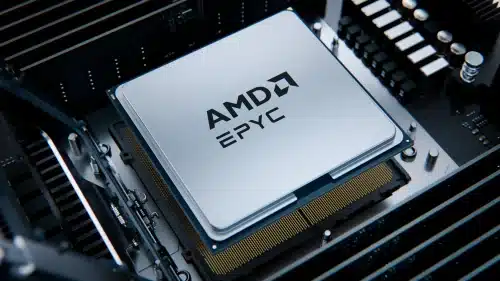
AMD has launched the 6th Gen AMD EPYC server SP7 processors based on the “Zen 6” architecture. The company claims that the 6th Gen AMD EPYC is the world’s best server CPU portfolio. Rather than offering one processor configuration for every application, the portfolio is optimised for different workloads, with processors that can handle demanding computing tasks, high CPU density, higher clock speeds, high bandwidth and efficiency.
This approach improves performance and efficiency across agentic AI, enterprise services and rack-scale computing. The release states that a system powered by its EPYC 9996 CPU delivers up to 3.7 times the performance of an NVIDIA Vera CPU-based system. The AMD-based system can deliver up to 2.2 times the computing performance and up to 2.0 times the performance per dollar.
The company says its high-frequency host-node processors, with clock speeds of up to 5.3GHz, can deliver up to 1.8 times the LLM output throughput of previous-generation EPYC processors. It also claims that its high-density EPYC processors offer up to a 3.3x agents-per-CPU-watt advantage over NVIDIA Vera and up to a 2.5x agents-per-CPU-watt advantage over Intel Xeon 6980P.
The EPYC 9996-based servers can support approximately 1.18 times as many agents per rack as competing systems within the same 35kW power envelope. Different data-centre workloads need different types of CPUs, and AMD’s 6th Gen EPYC portfolio offers processors suited to these different requirements.
“AI is significantly expanding the role of the CPU across every layer of the data centre,” said Dan McNamara, senior vice president and general manager, Compute and Enterprise AI, AMD. “With 6th Gen AMD EPYC, customers can standardise on the proven x86 foundation while choosing a workload-optimised solution to run more agents, keep accelerated infrastructure fed and power the business-critical applications they depend on.”
Click here for the original announcement.
