





An AI model combines object detection, image segmentation and image classification, and runs on a single CPU core without relying on GPUs.
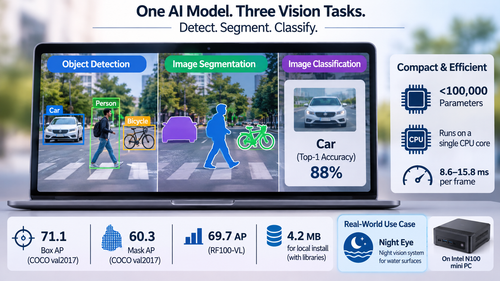
Comexp Research Lab has developed TAPe+ML v3.5, an AI model designed to perform three computer vision tasks using a single compact architecture. Most advanced computer vision architectures require a huge number of parameters and computational resources. According to Comexp, their technology modifies the way visual information is coded so that a model with less than 100,000 parameters can solve several recognition tasks.
The company’s approach is based on its Theory of Active Perception (TAPe). Instead of making the AI model bigger to improve its capabilities, the company is trying to make the way it processes visual information more efficient.
It has 71.1 box average precision (AP) in an object detection task on the COCO val2017 benchmark. Instead of using a rectangular box for an object, it recognises the pixels of the real object and draws the border of the object. Its mask AP on COCO val2017 is 60.3.
For image classification, it has a score of 88% in image classification, which was determined by using the measure of top-1 accuracy on the ImageNet-1k benchmark. The average precision (AP) value of 69.7 on RF100-VL (a set of diverse object detection datasets) indicates the ability to detect objects in different datasets.
According to an independent study conducted on the implementation of TAPe+ML, a local installation and libraries occupy 4.2MB and process frames within 8.6–15.8ms with a single CPU core.
One of the cases of its applications is Night Eye, a system of night vision that is used on the water surface. It uses TAPe+ML on an Intel N100 mini PC. However, the company stated that their models were not compared with TAPe+ML in the same hardware and under the same experimental settings. The benchmark accuracy and speed of CPU processing were measured separately.

