




Battery-powered devices could run Wi-Fi and AI locally while consuming less power and using fewer components.
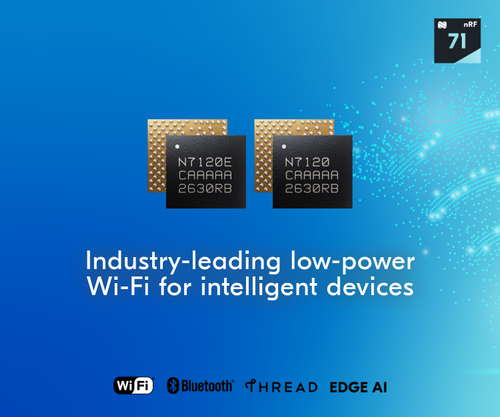
Nordic Semiconductor has launched the nRF71 Series of ultra-low-power Systems-on-Chip (SoCs). The SoCs have ultra-low-power Wi-Fi, Thread, Bluetooth Low Energy (LE) and edge AI on a single chip. The company claims that the series consumes up to 20 times less power in standby mode than the current-generation nRF70 Series Wi-Fi products. This makes the SoCs suitable for developers making battery-powered Wi-Fi devices for various applications, such as wearables, industrial IoT and smart homes.
AI inference can run locally on the chip instead of sending data to the cloud or relying on an external AI processor. So, it can respond faster, use less power and require fewer components. The nRF71 Series has an integrated Axon Neural Processing Unit (NPU), which runs machine-learning models 10–17 times faster than the 256MHz Arm Cortex-M33 processor running alone. It can perform keyword spotting, anomaly detection and image classification.
You can use Nordic’s Neuton software to create small AI models using your own data. These very small models can run directly on the processor without needing the NPU. The company combines its Axon NPU, Neuton software and over-the-air AI model updates through nRF Cloud to enable battery-powered Wi-Fi devices to run applications, wireless connectivity and AI processing on a single chip.
The two SoCs in the series are the nRF7120 and the nRF7120E. The nRF7120 comes with dual-band Wi-Fi 6, whereas the nRF7120E has tri-band Wi-Fi 6E and the Axon NPU for hardware-accelerated edge AI. Both have 4MB of on-chip non-volatile memory and 1MB of user-accessible RAM.
“Edge AI will be part of every connected device, but for those that run on a battery, Wi-Fi has demanded a power budget they could not afford,” said Kjetil Holstad, EVP Wi-Fi and Power Management, Nordic Semiconductor. “With the nRF71 Series, Nordic removes that barrier. We are bringing Wi-Fi and edge AI to the same ultra-low-power platform and tools developers already trust for Bluetooth LE, so the next generation of intelligent products can connect to any network, make decisions on the device, and still run for years on a battery.”
Click here for the original announcement.

