





Photonic chips can take the place of large-scale optical components of AR glasses because of the integration of lasers, modulators and light sources on one compact chip, which will make displays of AR glasses light-weight and energy-saving.
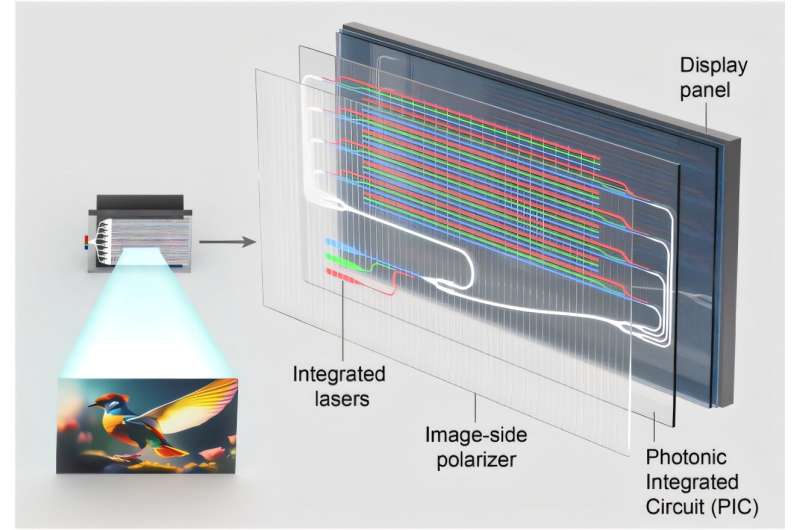
The history of computing shows how computers have evolved from being large computers to small powerful computers that can be carried around in our pockets. Such an advancement in the size of computers has been made possible due to the integration of the electronic components on one chip made possible through nanoscale structures that help in controlling the flow of electricity. The technology of integrated photonics has been developed for making smaller and lighter displays of AR using one chip by integrating the optical components.
“The concept behind integrated photonics is to make optics miniature like the way we made electronics miniaturised,” stated Zhujun Shi, Assistant Professor in the Department of Physics and Astronomy, University of Pittsburgh’s Kenneth P. Dietrich School of Arts and Sciences.
With optical communication serving as its primary motive, integrated photonics has been put to use in transmitting data using fibre-optic networking and data centers. Scientists have now expanded their scope and discovered uses other than optical communications, such as AR displays. Integrated photonics will enable AR glasses to become wearable all day by minimizing their size, weight, energy consumption and heating problems. Augmented reality glasses provide virtual objects in the physical world and have many potential uses in fields such as medical and industrial training. However, the biggest problem facing them is their wearability.
“There are some very demanding specifications. This device should be very small, light and highly efficient,” Shi explained. He further added that thermal management is critical because the energy that does not get converted to useful work creates heat, which is a problem with wearable displays. Conventional technologies use heavy optical elements, and it is hard to satisfy all of these specifications. Integrated photonics provides a solution as light generation and manipulation can be done with a chip-based approach. Shi and his colleagues from the University of Pittsburgh developed a flat-panel display using photonic chips that incorporate a full laser projection system in one chip with millions of microscopic light sources.
Based on these developments, Nature requested that the Pittsburg group together with collaborators from the Massachusetts Institute of Technology (MIT), the University of Washington, IMEC, Meta, TDK and Goertek produce a perspective paper proposing a roadmap for developing photonic-based AR technologies. The results demonstrate how the integration of photonic could be used not only for data transmission but also to build optical systems for next generation wearables.
Design of Photonic Chips Presents Difficulties with Visible Light
Creation of photonic chips for AR displays implies the development of a chip of several millimeters size, incorporating lasers, optical switches, and light emitters working with the visible spectrum of red, green, and blue light for millions of pixels. In contrast to communication photonic chips operating mainly at infrared frequencies, the display ones work with visible light.
How do you use an existing technology which is mature at longer wavelengths at these shorter wavelengths?” asked Zhujun Shi, assistant professor at University of Pittsburgh.Developing optical switches, modulators is another obstacle. Communications require fast modulators while displays require millions of modulators which are compact and low power instead of requiring very fast switching. One such architecture is when a laser source divides its emission successively into several beams. Each of these splits includes a modulator which manipulates the light thus saving on having thousands of lasers.Efficient laser sources are another developmental area especially in green wavelengths.
Three Ways Of Generating Photonic Images
The three ways of generating images other than those generated by the traditional displays include generating images where there is integration of display functionality within the lens placed before the eye. The three methods include:
- Beam steering method which rapidly steers the beam of light at various locations in order to generate the image.
- Synthetic aperture which uses many precisely coordinated sources of light to create an image.
- Holography which reconstructs a full three-dimensional image and is likely to reduce the problem of eye fatigue caused by viewing three-dimensional content in AR application.
All three methods will have different optical and laser systems to be used in the process. For example, beam steering and holography will have different laser sources. There is also the issue of the human eye and the perception of the human eye especially with the speckles created by the laser.
Integrated Photonics Requires Cross-Industry Collaboration
Moreover, visible-light integrated photonics may benefit quantum computing and biological imaging applications, where quantum computing involves atomic and ionic devices and uses visible light to manipulate individual atoms or ions, and biological imaging requires the use of visible light to analyse samples. Integrating optical devices into chips may allow for reducing the size of equipment and developing more compact imaging devices with applications in health care.
The researchers mention that the success of the optical communication integrated photonics is the best example of how the process can be accelerated by using such a strategy. The technology gained popularity when the industry started creating common fabrication platforms, which allowed for more widespread use and standardization.A similar method can prove useful for the advancement of visible-light photonics through the cooperation of researchers and industry participants in determining technical needs, manufacturing issues and priorities of the development process. Shi noted that a coordinated effort of the industry is necessary: “As a community, we need to understand the different requirements, plan a road map and identify the shared ingredients and shared challenges, and then we can bring the revolution of miniaturisation to AR displays.”
