





Tiny Chips Track Chemical Reactions In Real Time

A reaction-monitoring system uses microchips to collect measurements and track changes as chemical reactions take place.
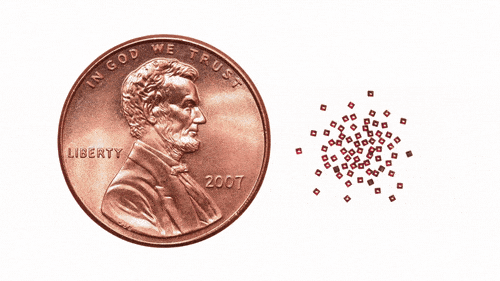
The chips used in the reaction telemetry system are called Optical Wireless Integrated Circuits, shown here next to a penny for scale. Each chip is 0.5 mm in size and powered by light. It can measure temperature and communicate optically (the red blinking seen in the video) with an onboard laser. | Michael Reynolds, OWiC Technologies

Researchers from Stanford University have developed a “reaction telemetry” system. They have placed very small chips inside test tubes used for chemistry experiments. These chips, which are as small as a grain of rice, can measure the heat produced or absorbed as a chemical reaction takes place. The chips can take a new reading every half a second, thus making it possible to track the process in close to real-time.  Traditional methods often provide only the final result after a reaction is complete. Other methods may require expensive equipment or interfere with the experiment. The tiny chips offer frequent readings right within the test tube.

With the help of the chips, the researchers are able to see when the catalyst becomes clogged or ceases to work in a chemical reaction. Sometimes, some substances in the chemical reaction may cling to or react with the catalyst. This makes the catalyst ineffective in performing its role. This phenomenon is known as catalyst poisoning.

The team conducted several experiments, adding a different suspected catalyst poison to each test tube. The tiny chips inside the test tubes recorded heat changes every half-second. Because the chips collected data so frequently, researchers could observe how the reaction changed after the suspected poison was added. With this information, they could change the chemical mixture or adjust the reaction conditions to prevent the poison from interfering with the catalyst.

Likewise, they detected when a reaction was producing too much heat, which poses a safety issue. They ran the experiment on a small scale using real-time data from the chips and could identify when a reaction generated a lot of heat and when it generated less.

The researchers believe that these wireless microelectronic devices could be designed to measure various factors such as light transmission, electrical conductivity and acidity. The system could also be used in other scientific fields that require high-throughput analysis, where large volumes of data need to be collected and processed quickly.


Loading form…
Nidhi Agarwal
Nidhi Agarwal
Nidhi Agarwal is a Senior Technology Journalist at Electronics For You, specialising in embedded systems, development boards, and IoT cloud solutions. With a Master’s degree in Signal Processing, she combines strong technical knowledge with hands-on industry experience to deliver clear, insightful, and application-focused content. Nidhi began her career in engineering roles, working as a Product Engineer at Makerdemy, where she gained practical exposure to IoT systems, development platforms, and real-world implementation challenges. She has also worked as an IoT intern and robotics developer, building a solid foundation in hardware-software integration and emerging technologies. Before transitioning fully into technology journalism, she spent several years in academia as an Assistant Professor and Lecturer, teaching electronics and related subjects. This background reflects in her writing, which is structured, easy to understand, and highly educational for both students and professionals. At Electronics For You, Nidhi covers a wide range of topics including embedded development, cloud-connected devices, and next-generation electronics platforms. Her work focuses on simplifying complex technologies while maintaining technical accuracy, helping engineers, developers, and learners stay updated in a rapidly evolving ecosystem.

SHARE YOUR THOUGHTS & COMMENTS

Latest DIY Projects

Electronics News

Truly Innovative Electronics

Electronics Components

Electronics Jobs