




- A reference design of an Electronic speed controller (ESC) intended for entry-level commercial drone designs.
- The design drives 3-phase brushless or permanent magnet synchronous motors (PMSM) with 6S LiPo or DC up to 30
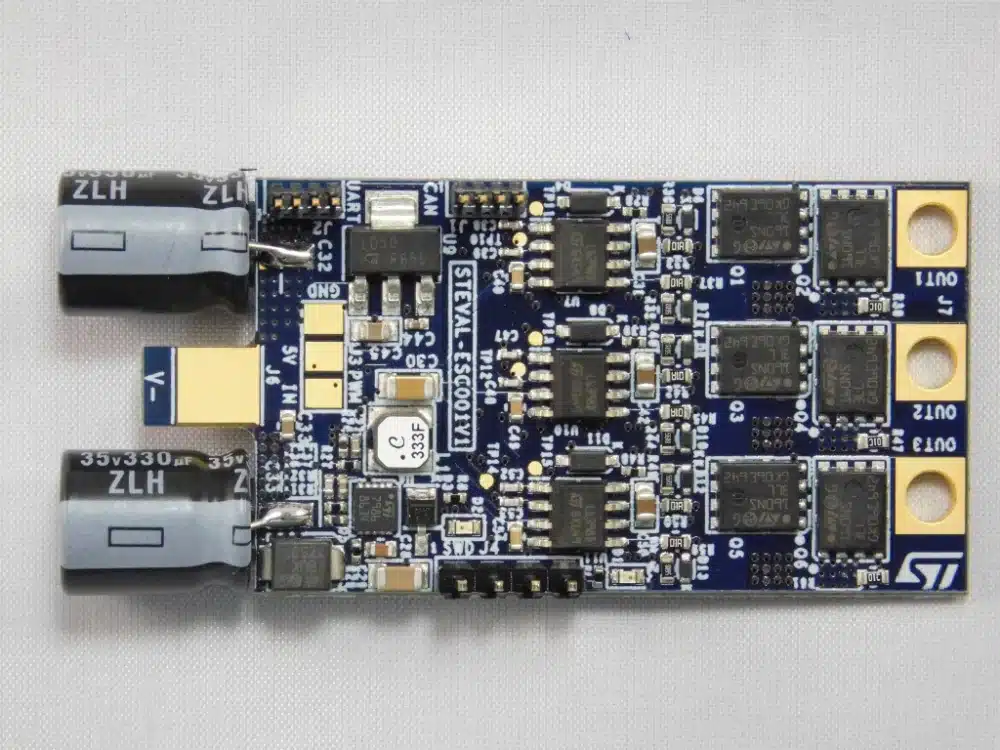
Electronic speed controllers (ESCs) are essential for controlling the speed of electric motors in various applications, such as drones, remote control vehicles, and model aircraft. ESCs regulate the voltage and current supplied to the motor, enabling precise speed control and preventing damage from overloading. To simplify the design process, STMicroelectronics has launched a reference design of an ESC intended for entry-level commercial drone designs. The design can drive any three-phase brushless or permanent magnet synchronous motor (PMSM) powered by 6S LiPo battery packs or a comparable DC power source with a peak current capacity of up to 30A. The ESC design enables the rapid spinning of a motor and its propeller with the assistance of the STM32 Motor Control Software Development Kit (MCSDK). The design suits various applications such as drones, Advanced Driver Assistance Systems (ADAS), automotive motor control, etc.
The ESC design features some communication interfaces like controller area network (CAN) , universal asynchronous receiver-transmitter (UART), Inter-Integrated Circuit (I2C), Pulse Width Modulation (PWM) and Serial Wire Debug (SWD). This reference design provides a comprehensive solution for implementing an electronic speed controller that utilizes a sensorless field-oriented control (FOC) algorithm. The design runs at a nominal operating voltage range of 11.1 to 22.2 V and provides a maximum root mean square (RMS) output current of 20 Arms. The reference design includes a battery eliminator circuit functioning at 5V, a Negative Temperature Coefficient (NTC) sensor for temperature measurement, and circuitry for overcurrent/overvoltage protection (OCP/OVP). Due to its compact size and current capacity, this reference design is ideal for electronic speed controllers on small and lightweight unmanned aerial vehicles (UAVs), such as professional drones.
The design can be refined by adjusting the FOC parameters and testing them with the motor profiler to obtain the motor parameters quickly. This design’s ST sensorless FOC algorithm guarantees extended flight durations and optimal dynamic performance. The ESC has a Battery eliminator circuit (BEC) working at 5 V/0.5 A for an external receiver or flight control unit (FCU). The reference design is assembled on the compact Printed Circuit Board (PCB) of size 29.1 x 58 mm. The output peak current of the ESC board is claimed to be 30 A by the company. The core components of the design include the STripFET F7 power MOSFETs, known for their high efficiency and low resistance, the STM32F303CBT7 microcontroller with an Arm Cortex-M4 core, and the L6398 drivers, which offer excellent performance. These components form the foundation of the design, ensuring reliable and efficient operation.
This reference design has been tested by STMicroelectronics. It comes with a Bill of Material (BOM), schematics, etc. You can find additional data about the reference design on the company’s website. To read more about this reference design, click here.

