


A function generator produces square, sine, and triangular waveforms across frequencies up to 100kHz. It plays a vital role in testing, repairing, and developing electronic equipment, serving as a signal source for amplifier testing and frequency response analysis.
At its core, an oscillator generates sine, square, or triangular waves, which are transformed into other waveforms through wave-shaping circuits.
POC Video Tutorial
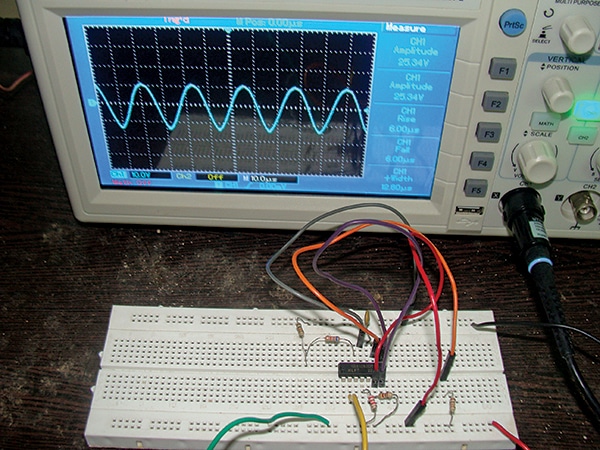
The breadboard prototype demonstrates this functionality, with the sine waveform output captured on an oscilloscope, as shown in Fig. 1.
| Parts List |
| Semiconductors: IC1 – ICL8038 function generator Resistors (all 1/4-watt, ±5% carbon): R1, R2 – 2.2kΩ R3 – 10kΩ R4 – 82kΩ VR1, VR2 – 10kΩ potmeter Capacitors: C1 – 3.3nF (3300pF) ceramic disk C2 – 33nF (33000pF) ceramic disk Miscellaneous: CON1-CON4 – 2-pin connectors S1 – Single-pole, double throw (SPDT) switch |
Function Generator Circuit and Working
Fig. 2 shows the circuit diagram of the function generator using the ICL8038, which produces sine, square, and triangular waveforms simultaneously with minimal external components. Capacitor C1 is charged and discharged by two current sources.
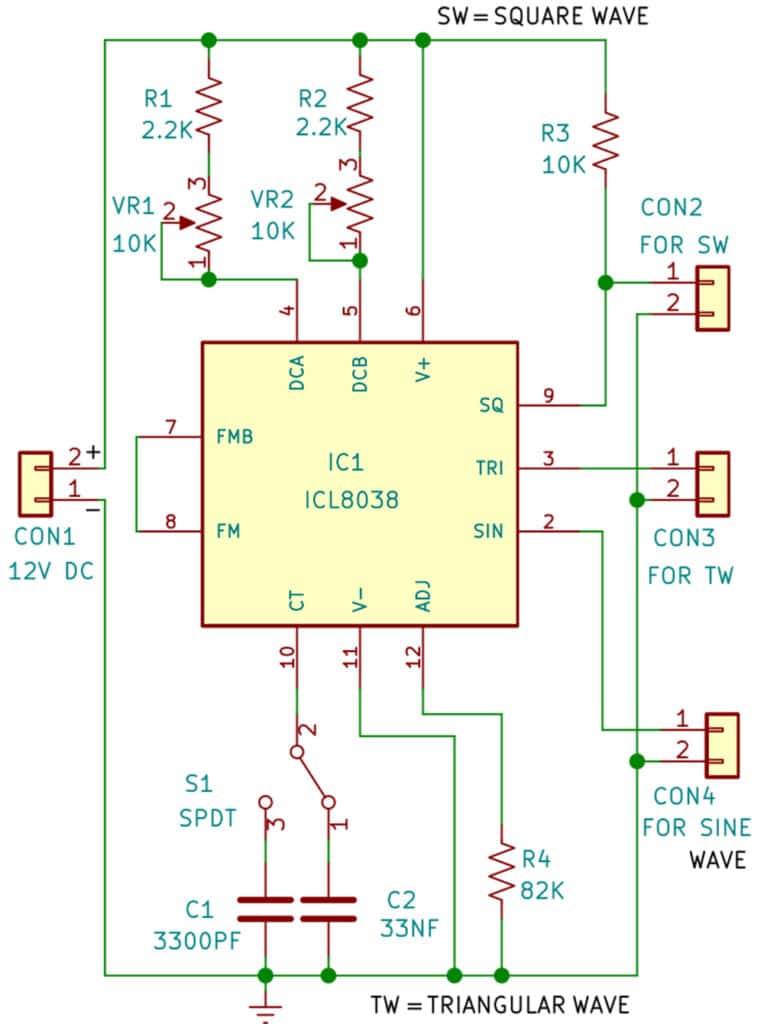
The ICL8038 incorporates two built-in constant current sources: Current Source 1 operates continuously, while Current Source 2 toggles via a flip-flop.