




E-mobility is evolving with a 97.2% efficient, compact 11 kW SiC bi-directional DC/DC converter design for EV charging and energy storage systems.
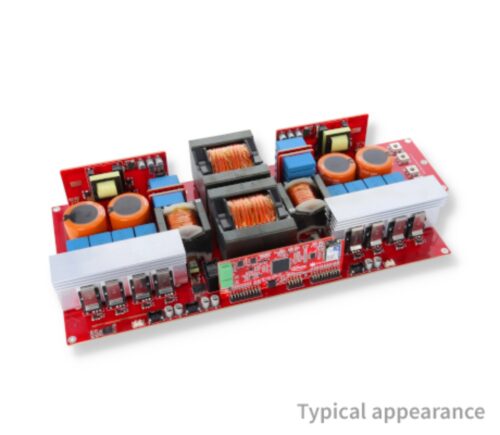
E-mobility is rapidly transforming both private and public transportation, reducing air pollution and enhancing our planet’s livability. Additionally, energy storage systems offer the potential to conserve energy by optimising its distribution. Infineon Technologies has launched the reference design of an 11 kW SiC bi-directional DC/DC converter board for Electric Vehicle (EV) Charging and Energy Storage System (ESS) applications. The REF-DAB11KIZSICSYS board is designed to offer a solution for bi-directional DC-DC converters, facilitating rapid and unique bi-directional charger designs for customers. The two inductors and two capacitors (CLLC) resonant DC-DC converter boasts bi-directional energy flow and soft-switching features, making it optimal for both on-board and off-board chargers and energy storage systems (ESS).
The reference design encompasses a fully fleshed-out and characterised hardware and software solution complemented by an intuitive graphical user interface (GUI). It ensures seamless integration of CoolSiC MOSFETs with Infineon’s driver IC, XMC controller, flyback controller, voltage regulator MOSFETs, current sensor, and Cypress memory, along with a security & safety chip. The design features a CLLC in a full-bridge setup. The CLLC resonant converter is favoured as a DC transformer connecting the AC/DC to the DC bus due to its high power density and bi-directional power transfer capability. In both forward and reverse modes, the resonant tank mirrors the operational traits of the traditional LLC resonant tank. As a result, soft switching with both Zero Voltage Switching (ZVS) and Zero Current Switching (ZCS) can be attained in both directions, reducing switching losses and enhancing charger efficiency.
The design achieves a high efficiency, consistently hitting or exceeding 97.2%. With a high power density of 4.1 kW/l, it incorporates synchronous rectification and is equipped with 1200 V and 1700 V MOSFETs. This makes it the perfect DC-DC converter for DC EV charging wall boxes and energy storage systems. It enables attractive business models like Vehicle-to-Grid (V2G) and Vehicle-to-Building (V2B) for end-users and ensures minimum losses during any charging and discharging cycle. Its compact size and reduced weight facilitate easy installation and boast a low cost per kW at the system level. The board measures 360 mm x 160 mm x 65 mm, translating to a power density approximating 3 W/cm³ (or 5.5 W/g). The industrial-qualified design is tailored for chargers ranging from 30 kW to 150 kW and power conversion systems. Its primary target applications include EV charging, energy storage, and medical devices.
Infineon Technologies has tested this reference design. It comes with a Bill of Materials (BOM), schematics, Printed circuit board (PCB) layout, etc. You can find additional data about the reference design on the company’s website. To read more about this reference design, click here.
