




An ESP32-C5-based detector scans 2.4GHz and 5GHz bands to identify suspicious RF interference using software-defined radio techniques.
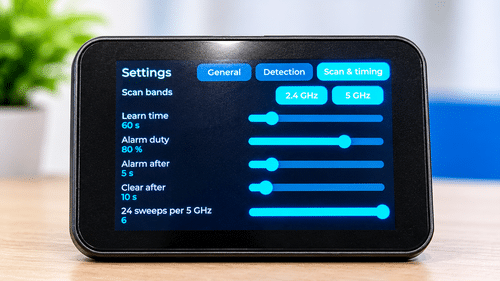
A device created by TheDigital1 transforms the Waveshare ESP32-C5-Touch-LCD-3.5 board into an RF interference detector. Unlike most systems which either send signals and interfere with Wi-Fi connectivity or block networks, the RF interference detector uses the Wi-Fi bands at 2.4GHz and 5GHz frequencies in order to detect abnormal interference patterns, which may be used for jamming purposes. The ESP32-C5 Wi-Fi receiver acts as a low-duty-cycle SDR, based on the ESPARGOS ESP-SDR project. The processed data is displayed on the touch screen of the board.

Firmware scans for the available channels within the frequency range of 2.4 GHz to 2.4835 GHz and 5.15 GHz to 5.895 GHz at intervals of 48 MHz with the rate of 80 million samples per second. In this process, the received data is analysed using the 1024 point FFT algorithm to create a spectrum divided into 312.5kHz frequency bands. Interference detected by the analyser is classified into four categories including wide band, narrow band, pulsed wide band, and frequency swept signals. Data is compared with the baseline obtained in 60 seconds and classified into NORMAL, SUSPECT, and ALARM.
The system operates as a standalone device without requiring a computer, smartphone or network connection. It may also communicate with the computer using the USB cable where a bridge program gives the detection alerts to the Home Assistant using MQTT discovery. With this, users may track the occurrences of the interference and be able to create alerts for home automation. The microSD card will save the detection state changes and waterfall in case of alarms. It runs on receive-only mode, and it does not use its Wi-Fi connectivity during the scanning. More importantly, it detects the change in the activity of the radio frequencies but not the intentionality of the source because microwave ovens may also interfere with them.
The whole firmware code, source code, build guide, and the Home Assistant Integration can be accessed on GitHub and licensed under the GNU General Public License 3.0 (GPL-3.0). Programmers can change the detection algorithm, set new parameters for scanning frequencies, and customise the software to work with other ESP32-C5-compatible devices. The project also includes a ready-to-use firmware binary file for flashing the device without having to compile the source code.

For more information, click here.


