




This family integrates low forward voltage, ultrafast and hyperfast switching, and extended creepage distances for power conversion at high voltages.
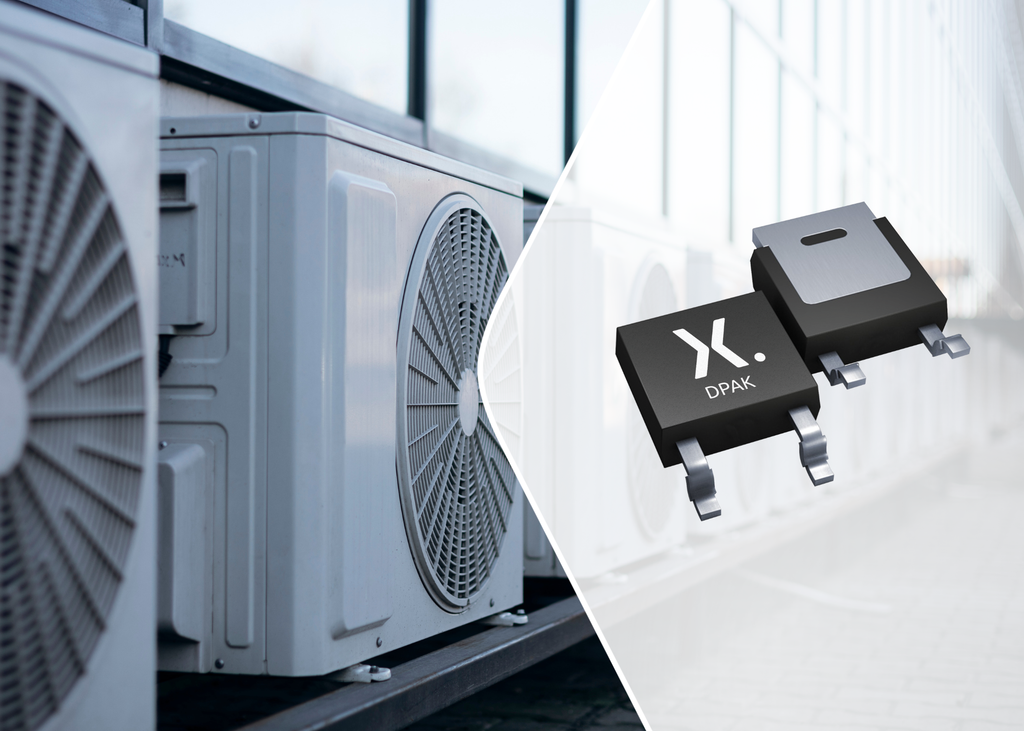
The new series of 400 V and 650 V fast-recovery rectifier diodes by Nexperia increases the number of possibilities for automotive and industrial power conversion applications. This 48-component family incorporates low forward voltage drop with ultrafast and hyperfast reverse recovery properties so that the engineers can optimize switching losses based on their particular applications.
These diodes come in a DPAK (TO-252) Real-2-Pin (R2P) package; the R2P device removes the standard centre lead pin to provide an increase in creepage and clearance distances up to 3.6 mm between the anode and cathode pins.
The key features are:
- 48-device portfolio covering 400 V and 650 V ratings.
- Current ratings spanning 4 A to 15 A.
- PNU ultrafast and PNE hyperfast recovery variants.
- Real-2-Pin package with 3.6 mm anode-to-cathode spacing.
- Typical reverse-recovery time of 27 ns for the PNU650100EH.
The devices included in the portfolio range between 4 A to 15 A in current ratings and fall under two types of products – PNU ultrafast rectifiers and PNE hyperfast rectifiers. The portfolio thus provides various trade-offs between forward voltage and reverse recovery parameters.
One of the devices available in this portfolio is the PNU650100EH that belongs to the 650 V ultrafast recovery rectifiers rated at 10 A. It has a VF rating of 1.2 V and a reverse recovery of 27 ns. The electrical specifications of the device are ideal for use in PFC circuits as boost diodes.
The semiconductors have been specifically designed to work in the field of single-phase, low-power automotive on-board chargers, industrial power supplies and air conditioners. The efficiency of the rectifier becomes important for achieving maximum efficiency and heat dissipation in these systems. Lowering of forward voltage leads to lower conduction loss, while quick reverse recovery makes it suitable for switching applications.
The silicon-based rectifiers also help to expand the portfolio of power converters by providing additional option to the designers along with the silicon carbide (SiC) Schottky diode. Designers can choose a solution which will be more cost-effective or performance-oriented depending upon the application.
Click here for the original announcement.
