





What if an AI agent could keep working on your files without sending them to the cloud? A compact PC aims to put the local AI processing at the centre of its design.
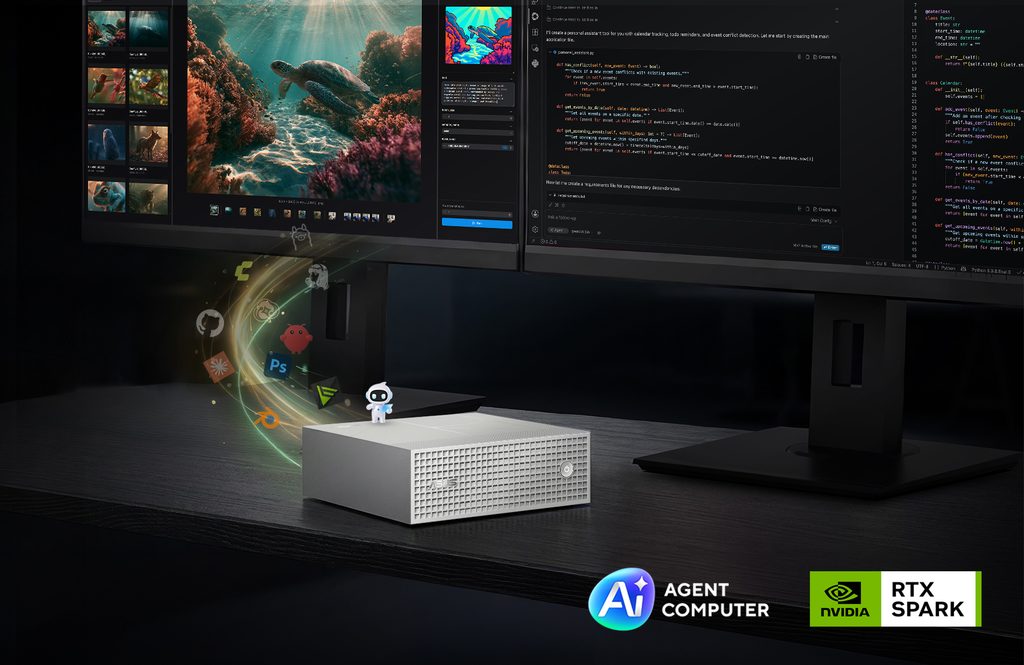
ASUS has launched the ProArt GR1X which can constantly run AI agents on Windows 11. Using NVIDIA’s RTX Spark platform, it can locally execute large AI models so that the AI agents can interact with a user’s data and software again by not necessarily uploading everything to the cloud.
Large language models (LLMs) of up to 120 billion parameters are supported, together with context lengths of up to 1 million tokens. This enables AI agents to process significant data and programming. As such, users can also bypass costs incurred by being charged per token or generation for local operations.
Whilst local execution is available, users can also utilise the cloud or indeed a hybrid solution, according to their needs in terms of function, expense and confidentiality. Furthermore, the device is compatible with NVIDIA’s CUDA technology on Windows 11 and is enhanced for 3D, video and AI by an RTX graphics card. Additional gaming capabilities include DLSS, Reflex and ray tracing.
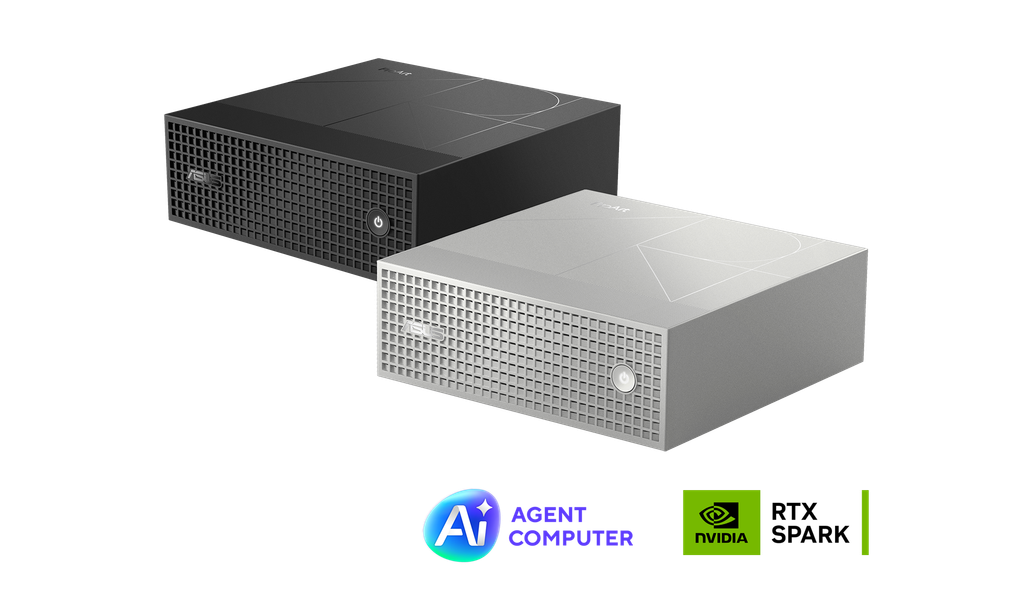
Internally, the ProArt GR1X is fitted with a 20-core NVIDIA Grace central processing unit (CPU), as well as a 6,144-core Blackwell RTX graphics processing unit (GPU). The two components are linked via NVLink-C2C and have shared memory. Memory options provide either 64GB or 128GB.
As the device must operate non-stop, effective cooling is necessary. Measuring 150 x 150 x 51mm and having a weight of 1.48kg, the desktop PC cools itself using two fans fitted with 218 fan blades. These are backed-up by 57 wide, ultra-fins and four heat pipes in order to dissipate heat associated with the device’s 140W thermal design power. Fan rotation speed can be set to seven different levels.
For connectivity, the device can offer 10GbE LAN, Wi-Fi 7, Bluetooth 5.4, four USB 3.2 Gen 2×2 Type-C ports and HDMI 2.1. It can support up to four 4K displays, with HDMI output up to 8K, and has two M.2 NVMe SSD slots supporting PCIe 5.0 and 4.0.
Click here for the official announcement.
