The photorelay improves semiconductor testing with performance, design, and versatility in high-speed applications.
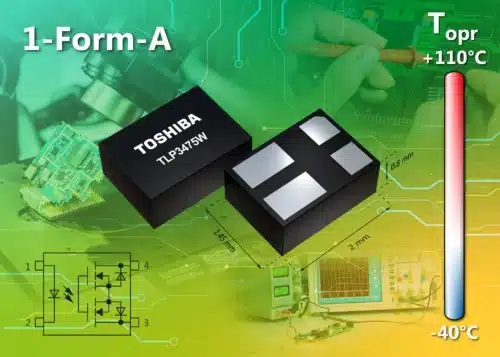
Toshiba Electronics Europe GmbH has introduced a new photorelay, the TLP3475W, designed to enhance the performance of high-frequency signal applications. This device is mainly aimed at semiconductor testing, including high-speed memory, logic testers, and probe cards.
The applications of this technology are diverse and include measuring instruments, high-speed memory testers, and high-speed logic IC testers. It is also extensively used in Automatic Test Equipment (ATE) and probe cards. These varied applications showcase its versatility in different testing and measurement scenarios.
The TLP3475W has a design that minimizes parasitic capacitance and inductance, reducing signal insertion loss at frequencies around 20GHz. This marks an enhancement over the previous model, TLP3475S. Features of the TLP3475W include a current requirement of less than 3.0mA to drive the LED, an on-state resistance of 1.1Ω, and an isolation voltage exceeding 300Vrms. Its output capacitance is under 20pF, contributing to switching times of approximately 2ms. The photorelay offers a normally open (NO) function, or 1-Form-A.
The product includes features such as a WSON4 package with dimensions of 1.45 mm × 2.0 mm and a height of 0.8 mm. It operates with a normally open (1-Form-A) configuration and an OFF-state output terminal voltage of at least 60 V. The LED trigger current is 3 mA, while the ON-state current can be up to 0.4 A. Its ON-state resistance is a maximum of 1.5 Ω. The output capacitance is 12 pF, going up to 20 pF. An aspect is its isolation voltage, which is a minimum of 300 Vrms. The product is halogen-free, as detailed in the “Devices in Halogen-Free Resin Packages” section of the datasheet. It features an insertion loss of 3 dB at a frequency of 20 GHz.

The TLP3475W is smaller than the S-VSON4T package from Toshiba, which is beneficial in multi-channel designs where space is limited. Its operating temperature range of -40ºC to +110ºC makes it suitable for industrial applications, including high-speed semiconductor testing.
For more information, click here.