




A Heriot-Watt researcher has built a Raspberry Pi 3-based skin lesion screening device that classifies images offline with reported accuracy of 85 per cent.
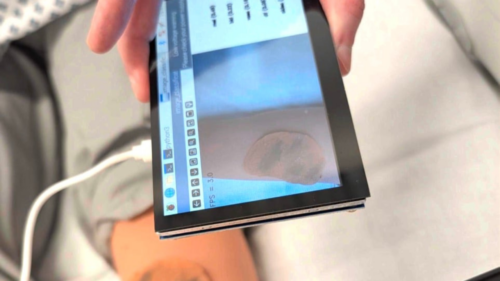
Tess Watt, a PhD candidate at the School of Mathematical and Computer Sciences at Heriot-Watt University in Edinburgh, has developed a skin lesion screening device called LesionIQ. The system runs on a Raspberry Pi 3 Model B with an attached camera and is designed to classify skin-lesion images directly on the device. The project was developed with contributions from researchers at London South Bank University, Edinburgh Napier University, and the Foundation for Research and Technology – Hellas in Greece.
The device uses on-device machine learning, running inference directly on the Raspberry Pi without requiring a network connection. The classification model and reference datasets are stored locally on the board, allowing images captured by the camera to be processed without sending them to an external server. According to Watt, machine learning can identify visual patterns that may not be apparent to the human eye. The Raspberry Pi 3 Model B uses a quad-core Arm Cortex-A53 processor and 1 GB of RAM, with no dedicated neural-processing accelerator, so the model must be optimised to operate within its available computing and memory resources. The approach prioritises offline operation and data privacy while avoiding dependence on cloud computing.
The system has reported 85 per cent test accuracy when evaluated using the ISIC 2020 Challenge dataset, while an earlier evaluation using the HAM10000 dataset achieved 78 per cent test accuracy. The underlying work was published by Tess Watt and colleagues in Applied Sciences, where they demonstrated the use of a Raspberry Pi with a webcam to run skin-lesion classification without an internet connection. The result provides a research basis for the 85 per cent figure reported for LesionIQ, but it should not be interpreted as 85 per cent clinical diagnostic accuracy across all skin cancer cases. The project is intended to support early detection, and the Raspberry Pi-based approach allows images to be processed locally rather than uploaded to a cloud service.
Some smartphone-based alternatives photograph a lesion and send the image to a cloud-based classifier. Such systems can require a smartphone and network connection, while patient images may also leave the device. Professional clinical dermatoscopes can cost considerably more than a single-board computer, particularly at the higher end of the clinical market. LesionIQ instead processes images locally and does not require a smartphone or internet connection, changing both the hardware requirements and the way patient-image data is handled.
This is a research prototype, not an approved medical device. Watt is in discussions with NHS Scotland regarding ethical approval, which remains pending, and expects real-world patient use before 2030. The project also faces a significant data challenge: Watt identifies the lack of sufficiently diverse skin-lesion datasets for training as one of the main limitations of the system. Until the device is tested on broader patient populations and goes through the appropriate clinical and regulatory processes, the reported 85 per cent accuracy should be treated as a research result rather than evidence of clinical diagnostic performance.
That limitation is particularly relevant to India. Public dermatology datasets have historically had uneven representation of darker skin tones, which can affect how reliably an AI model trained on those datasets performs across different patient populations. The exact degree of under-representation varies between datasets, so a specific percentage should not be quoted without identifying the dataset and supporting study. For an Indian deployment, locally representative training and validation data would therefore be important. The hardware design, meanwhile, fits environments where connectivity can be unreliable. An offline classifier could allow images to be processed without sending them to a cloud service. Any Indian deployment intended to provide diagnostic support would also need to be assessed under India’s medical-device regulatory framework, with the applicable CDSCO classification depending on the software’s intended use and risk level. An inexpensive, offline computing platform could make screening systems more portable, but representative local clinical data and appropriate validation would determine whether such a system is accurate enough for Indian patients.
For more information, click here.

