





The bridge boards use Rockchip’s RK628H chip to convert HDMI inputs into MIPI CSI-2 streams for embedded video capture.
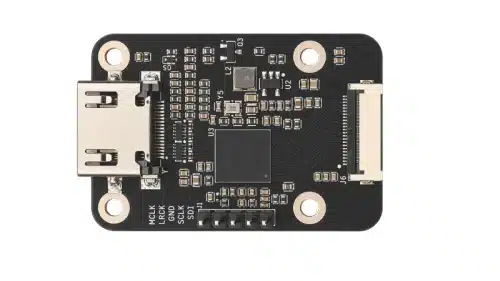
WarpKVM has published three bridge board designs centered on Rockchip’s RK628H video interface chip, letting embedded systems ingest standard HDMI signals through their native MIPI CSI-2 camera ports. Aimed at IP-KVM switches, capture rigs, and embedded vision builds, the designs bypass bulky USB capture dongles in favor of direct board-level video routing.

Rather than settling on a one-size-fits-all layout, WarpKVM split the hardware into three variants tailored to different host pinouts and bandwidth needs. The compact RK628-22P uses a 22-pin, 0.5mm-pitch FPC connector with a single four-lane MIPI CSI-2 interface, hitting up to 4K at 30fps or 1080p at 120fps depending on the host processor. Stepping up to a 30-pin connector, the RK628-30P adds an onboard DAC and a 3.5mm jack for analog audio breakout. For higher-bandwidth workloads, the RK628-2x22P doubles up with two 22-pin connectors to provide dual four-lane MIPI CSI-2 links, unlocking capture rates up to 4K at 60fps.
Depending on the board, HDMI audio is routed either digitally over I2S or through the onboard DAC. To make the hardware usable out of the box, the repository bundles Linux kernel driver patches, device tree overlays, setup scripts, and custom EDID profiles. Those software tweaks tackle common capture headaches like HDMI hot-plug recovery, audio stream reporting, and MIPI lane-rate bottlenecks, while allowing live EDID updates without unplugging the HDMI cable.
Validation testing spans several popular single-board computers and modules, including the Raspberry Pi 4B, Raspberry Pi Compute Module 4, Luckfox Aura, and Firefly ROC-RK3576-PC. Engineers can use the bundled diagnostic scripts to verify incoming HDMI timings and grab raw test frames during bring-up.
All manufacturing files, including schematics, PCB layouts, Gerbers, bills of materials, and assembly guides, are hosted on GitHub under the CERN Open Hardware Licence Version 2 (Strongly Reciprocal, CERN-OHL-S-2.0), with supporting kernel code and scripts licensed under GPL-2.0.
For more information, click here.