





Researchers created a stretchable organic transistor that changes function through salt concentration, enabling smarter wearable electronics capable of sensing, processing and storing physiological information.
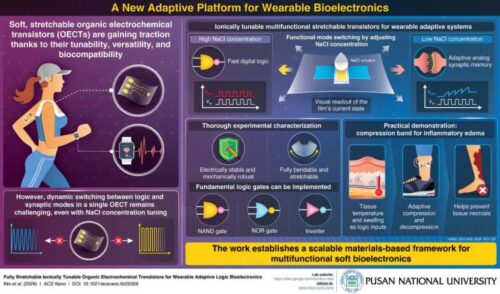
Researchers at Pusan National University have developed a stretchable organic electrochemical transistor (OECT) that can switch between different electronic functions simply by altering the surrounding salt concentration. The technology is designed to reduce the complexity of wearable electronics by allowing a single soft device to perform multiple roles, including sensing, computing and memory storage.
Most wearable electronic systems currently rely on several separate components to collect signals, process information and store data. This increases device size, power consumption and manufacturing costs while reducing flexibility. The research team addressed this challenge by creating a reprogrammable transistor capable of adapting its behaviour without requiring additional circuitry.
The device operates by moving ions through a conductive polymer. By changing the concentration of sodium chloride in the surrounding electrolyte, the transistor switches between digital logic operations and analogue, brain-like memory functions. Higher salt concentrations enable rapid on/off switching suitable for digital computation, while lower concentrations create analogue behaviour resembling the signal transmission of biological synapses.
To improve durability, the researchers modified the conductive polymer with two additives that enhance both electrical conductivity and mechanical stretchability. The transistor also changes colour from light blue to dark blue as it switches operating modes, providing a simple visual indication of its current state without requiring external monitoring equipment.
As a proof of concept, the team integrated the technology into a wearable patch capable of detecting inflammatory swelling and skin temperature. The patch automatically adjusts the tightness of a compression band in response to physiological changes, helping reduce the risk of tissue damage.
The researchers believe the platform could support future smart electronic skins, wearable health monitors and implantable bioelectronics. They also suggest the adaptable transistor could contribute to low-power neuromorphic computing, soft robotics and intelligent prosthetic devices that continuously learn from and respond to their surroundings.


