

A robotics development platform that uses artificial intelligence, real-time control, connectivity and security technologies to simplify autonomous robot development and prototyping as well as support next generation of physical AI applications.
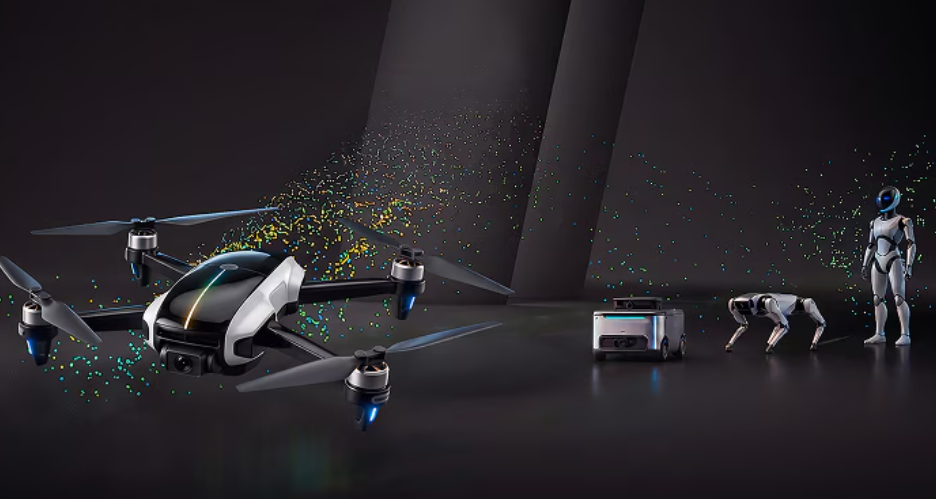
Autonomous robots development requires combination of such components as artificial intelligence (AI), sensing, motion control, connectivity and security. Unification of all these components in one robotics development platform helps to simplify autonomous robots development process.

NXP Semiconductors’ Unified Robotics Platform is based on their Neural Axis Architecture that links up sensing, real-time control, artificial intelligence processing, and communications for robotic systems. The platform combines pre-validated hardware and software modules for developers to build from modular building blocks to autonomous systems. The aim is to cut down integration and validation process time from a few months to just days or weeks.
The key features are:
- Supports PX4, Zephyr and Robot Operating System 2 (ROS 2) ecosystems.
- Includes middleware integration and reusable software components.
- Provides configuration tools for robotics system development.
- Enables independent activation of processor-level security and safety features.
- Supports modular expansion from individual subsystems to complete robotic architectures.
It comes with an open source, modular robotics software development kit (SDK) and reference designs. The software environment has drivers, middleware integration, reference application, and reusable components that enable the developer to develop perception, navigation, flight management, and motor control capabilities. The platform also consists of secure processing, deterministic real-time, and functional safety of robots in dynamic environments.
For the first reference designs, drones will be considered. The autonomous computing and flight control of the drones will be carried out by NavQ95 platform with i.MX 95 applications processor. The flight management will be provided by Tropic VMU/FMU which is designed on i.MX RT1064 crossover microcontroller (MCU). For the sensor networking capability, it uses 100Base-T1 Sensor Node with the MCX N947 MCU. Motor control will be carried out by AM32 compliant electronic speed controller which will be based on the MCX A13 MCU.
With such pre-integrated subsystems, it becomes possible to integrate computing, flight control, sensor networking, and motor control without developing and testing each one separately. The development platform makes it possible to get started with a basic drone in less than 30 minutes from the moment of the initial setup. Apart from drones, the platform is geared towards service robots, autonomous mobile robots (AMRs), and other autonomous systems that require real-time perception, navigation, communication, and motion control. It is designed to help develop scalable robots that can operate in the real world environment.
Click here for the original announcement.