

We’re all aware of lithium-ion batteries, but what about lithium-carbon dioxide batteries?
A group of interdisciplinary academics led by the University of Adelaide has set out to establish an environment for further rechargeable alkali metal-based carbon dioxide battery research, analysing appropriate electrodes, electrolytes, and catalysts along the way. The researchers worked on lithium-carbon dioxide batteries, which are fascinating not just for converting waste carbon dioxide into value-added products, but also for storing electricity generated by renewable energy sources and balancing the carbon cycle.
Li-CO2 battery technology is still in its infancy in practice. However, the statistics show a lot of promise. The theoretical specific energy density of these batteries is 1,876Wh/kg and they have a discharge potential of 2.8V.
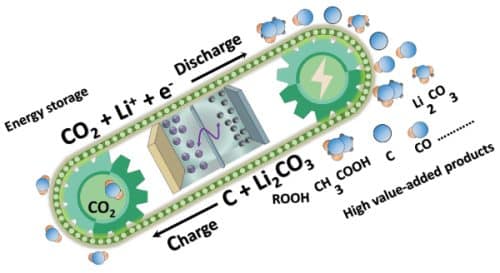
“Specifically, we have figured out that the basic understanding of the electrochemical mechanism but the performance at a high rate is still far from satisfactory for practical application due to the lack of efficient electro-catalysts,” said Adelaide chemical engineer Professor Zaiping Guo. “Despite the challenges, we have to say that, with continuous efforts, practical Li-CO2 batteries with efficient CO2 fixation and high energy storage are achievable.”
“The main concern for a lithium-carbon dioxide battery lies in the slow kinetics of the electrode reactions, so the next step in the development of lithium-carbon dioxide is to seek an efficient catalyst that can boost the electrode reactions during battery charge and discharge”, she said.
The highest demand for these Li-CO2 batteries would probably be in the aviation industry, since it demands lightweight hardware. The study titled “Challenges and Prospects of Lithium−CO2 Batteries” has been published in Nano Research Energy in March 2022. The authors anticipate that this study will serve as a resource for a thorough understanding of lithium-carbon dioxide batteries, as well as direction for future research into reversible and rechargeable alkali metal-based carbon dioxide battery systems.
You can access the study here.