




With the support of a new funding from the Office of Naval Research, a group of Cyclone Engineers hopes to expand the underlying understanding and capabilities of lithium-based batteries for naval applications.
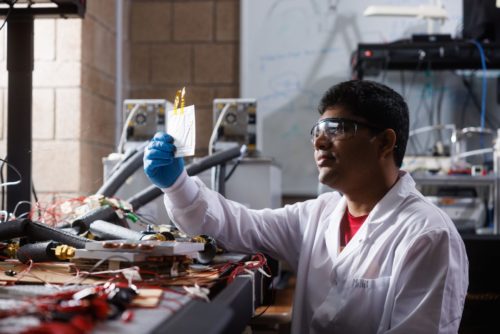
Todd Kingston, an assistant professor of Mechanical Engineering (ME), and Cary Pint, an Associate Professor of ME and the Charles Schafer (Battelle) Chair of Engineering, are two Iowa State University researchers working on a nearly $700,000 project titled “mechanistic determination of thermally induced electrochemical modifications in lithium batteries.” This effort will also include researchers from the US Naval Research Laboratory and Princeton University.
The researchers want to see how the basic mechanisms that make batteries work are affected when the battery is subjected to a thermal gradient, or a modest temperature variation across the cell as little as a few degrees Celsius. Kingston and his team have a deep understanding of how thermal events might affect Li-ion battery performance, as well as previous expertise with the subject.
“Thanks to the support from ONR, we have a unique opportunity to unravel some of the most fundamental and pressing thermo-electrochemical questions related to lithium-based batteries, which has applications ranging from defense to transportation to consumer electronics,” said Kingston.
Pint and his lab offer to the project a wealth of chemical and electrochemical battery experience. “A lithium-ion battery involves many materials and processes working together in harmony to store energy reliably and safely, similar to how many sections of instruments contribute to the powerful sound of a symphony,” said Pint. “This work will allow us to isolate mechanisms behind how thermal gradients across the battery can modify these processes, ultimately enabling the design of more robust and safer batteries in the future.”
Work on the project began in May 2022, and financing is expected to last until April 2026.


