

By transforming waste heat into electricity through a process known as thermoelectric conversion, waste heat has become a promising source for energy conservation and reuse. Rare metals are used in the synthesis of thermoelectric conversion devices that are available today. Although extremely effective, these are costly and frequently involve the use of harmful ingredients…
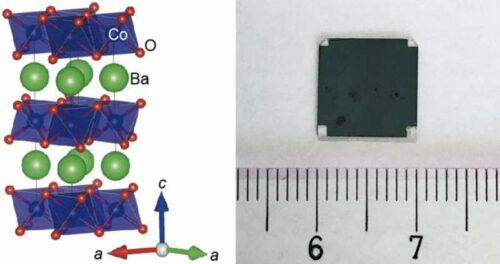
To solve this issue, a barium cobalt oxide thermoelectric converter that is stable and effective at temperatures as high as 600°C has been created by a team under the direction of Professor Hiromichi Ohta at the Research Institute for Electronic Science at Hokkaido University.
The Seebeck effect is what propels thermoelectric conversion: an electric current is produced when there is a temperature difference across a conducting material. The thermoelectric figure of merit, ZT, however, determines the efficiency of thermoelectric conversion. Ideally, converters should have high ZTs and should be stable at the same time.
Over two decades have passed since Hiromichi Ohta’s group began working on stacked cobalt oxide films. The team’s goal in this work was to assess the films’ thermal and chemical stability as well as their ZT values at high temperatures. They examined the structure, resistivity, and thermal conductivity of cobalt oxide films that were coated with sodium, calcium, strontium, or barium.
The barium cobalt oxide layered film was found to be the most stable of the four variations in terms of structural integrity and electrical resistance at temperatures as high as 600°C. In contrast, the strontium cobalt oxide film was stable up to 450°C while the sodium, calcium, and cobalt oxide films were only so for 350°C. By achieving 0.55 at 600°C, the ZT of the barium cobalt oxide film was equivalent to several currently available thermoelectric converters.
“Our study has shown that barium cobalt oxide films would be excellent candidates for high-temperature thermoelectric conversion devices,” said Hiromichi Ohta. “In addition, they are environment friendly, giving potential for wide deployment.”