Claiming to be the first of its kind, the wearable sensor detects multiple chronic wound biomarkers and rapdly enables wound management
It is estimated that nearly two per cent of the world’s population suffer from non-healing chronic wounds including diabetic foot and chronic venous leg ulcers. With timely care and proper treatment, patients can achieve fast recovery.
However, accompanying distresses such as infection, severe stress, pain and discomfort often disrupt the healing process, lengthening the treatment duration and adding to unnecessary healthcare costs.
As a solution to this problem, a research team at the National University of Singapore’s (NUS) Department of Biomedical Engineering and Institute for Health Innovation & Technology (iHealthtech) in collaboration with the Singapore General Hospital has developed a smart wearable sensor that can wirelessly conduct a real-time, point-of-care assessment of chronic wounds and also rapidly detect temperature, pH, bacteria type and inflammatory factors specific to chronic wounds, hence enabling fast and accurate wound assessment.
In contrast to current clinical practices for treating wounds that rely on collecting and sending wound fluid for lab assessment that usually takes about a few days, the newly developed medical assessment platform called VeCare consists of a wound sensing bandage, an electronic chip and a mobile app that can detect bacterial/fungal infections and probe inflammatory factors along with measuring acidity and temperature – all within 15-minutes.
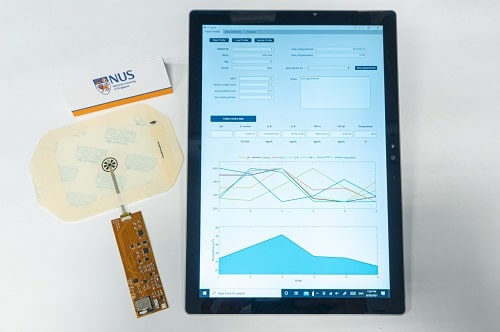
The bandage comprises a wound contact layer, a breathable outer barrier, a microfluidic wound fluid collector and a flexible immunosensor, enabling rapid assessment of wound microenvironment, inflammation and infection state by detecting multiple chronic wound-specific biomarkers from wound fluid. The microfluidic wound fluid collector delivers the wound fluid to the sensor, ensuring reliable sensing.
Additionally, a reusable, flexible electronics-based chip is powered by a rechargeable battery and connected to the sensor for transmitting data wirelessly to an app for real-time wound analysis.
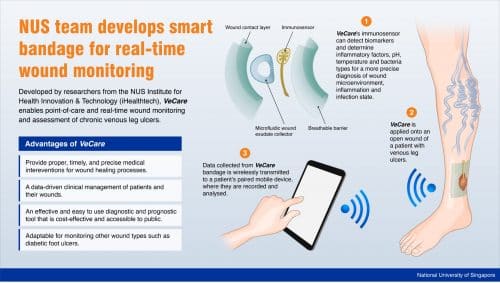
The VeCare platform enables healthcare professionals to remotely monitor chronic wounds, thus reducing the hassle involved in clinic visitations.
“Point-of-care devices coupled with telehealth or digital health capability can play a significant role in transforming the healthcare industry and our society, which is catalysed by the COVID-19 pandemic requirements for safe distancing. Our smart bandage technology is the first of its kind designed for chronic wound management to give patients the freedom to perform the test and monitor their wound conditions at home,” said Prof Lim Chwee Teck, Director of iHealthtech at NUS.
He further added, “The VeCare platform is easily scalable and customisable to accommodate different panels of biomarkers to monitor various types of wounds. The aim is to have an effective and easy to use diagnostic and prognostic tool for precise and data-driven clinical management of patients.”
The next step for the research team is to further develop VeCare by incorporating biomarkers that can detect other types of wounds and thus provide an improved diagnosis and treatment.