



HomeSpecialTruly Innovative ElectronicsWorld’s First Photon-Number-Resolving Scientific Camera

World’s First Photon-Number-Resolving Scientific Camera

It has incredibly low noise and 9.4 megapixels that enables accurate measurement of the number of photons to create an image
 

- Advertisement -

In quantitative imaging, the photoelectric noise generated during the conversion of light into electrical signals determines the lower detection limit of the camera.

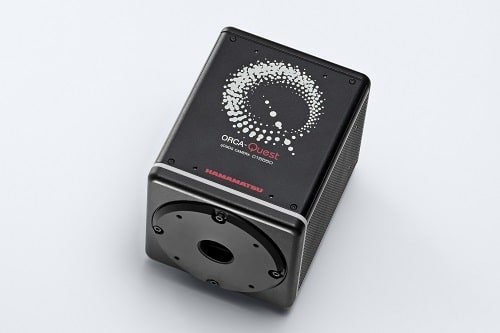
To generate even more accuracy, the ORCA-Quest qCMOS scientific camera C15550-20UP from Hamamatsu Photonics takes this photoelectric noise to a level below the signals generated by photons, making the ORCA-Quest the world’s first camera to achieve 2D photon number resolving measurement for accurately measuring the number of photons to create an image. For example, the ORCA-Quest can observe the quantum states of ions and neutral atoms more accurately, making it a promising tool for accelerating research and development of quantum technology for quantum computers and a host of other applications.

- Advertisement -

The ORCA-Quest qCMOS scientific camera has an incredibly low noise of 0.27 electrons rms and a high pixel number of 9.4 megapixels, made possible by a hi-tech two-dimensional CMOS image sensor.

The ORCA-Quest are in production and available for researchers at universities and companies both in Japan and overseas.



Vinay Prabhakar Minj
Vinay Prabhakar Minj is a technology writer and science communication specialist with a Master’s degree in Communication of Science and Innovation (Science Communication). He is a prolific contributor to Electronics For You, where he has authored over 1,000 articles covering electronics, semiconductors, embedded systems, IoT, and emerging technologies. With a strong foundation in science communication, Vinay focuses on translating complex engineering concepts into clear, accessible, and application-oriented content. His work spans topics such as sensor technologies, chip design, wireless systems, and next-generation electronics, making advanced innovations easier to understand for engineers, students, and industry professionals. Through his extensive contributions, he has built a reputation for delivering reliable, well-researched, and practical insights that help readers stay updated with the rapidly evolving electronics ecosystem. His writing bridges the gap between technical depth and real-world usability, supporting both learning and decision-making in the field.

SHARE YOUR THOUGHTS & COMMENTS

Most Popular DIY Projects

EFY Prime

Unique DIY Projects

Electronics News

Truly Innovative Electronics

Latest DIY Videos

Electronics Components

Electronics Jobs

Calculators For Electronics
