

For decades, we have been accustomed to x86 as a desktop architecture. The introduction of Atom processor based on x86 was expected to be the game changer. It was introduced by Intel to target embedded products like tablets and smartphones, which is a huge market for embedded processors going ahead.
So in a new embedded project, often the choice of the central processing unit (CPU) is limited to x86 and ARM—the two leading architectures. “The selection of processor is mainly based on factors like power requirement, price point of the product, performance requirement, support for interfaces, application domain and licence-free OS (if applicable),”
says Bhaskar Trivedi, program manager-embedded division, eInfochips.
According to Trivedi, for any embedded processor to succeed, support for low-power modes, availability of generic external interfaces and in-built capability for high-resolution graphics need to be considered. But it all ultimately depends on the kind of embedded application that you are designing. Many embedded developers believe that for pure embedded or smartphone type of applications ARM is preferable, while for PC-like performance x86 works well. Of course, there is an intermediate where things overlap. In some ways, it is like comparing between a sedan, van and pickup truck. It really depends on what you want to carry.
Leverage PC legacy
The biggest advantage of x86 platform is its desktop legacy. “There is seamless integration with the desktop world, where plenty of tools and applications are available, and the same can be used for embedded development. This way, testing and debugging become a lot easier than on any other platform,” shares Amit Sinha, CEO, Dexcel Electronics Design.
Software development on x86 is relatively easy because of desktop PC penetration. Sinha shares, “The native software developed for desktops will probably work directly on an embedded x86 platform without any cross-compilation.” This applies to applications too.
Justifying further, Nishant Sharma, chief technology officer, KritiKal Solutions, says, “Today, most embedded software projects are run on x86 first, even when the final working product is for another platform. It is one of the most common ‘proof of concept’ platforms. So most operating systems and real-time operating systems (RTOS) have support for x86.” As x86-based embedded platform has PC as the development platform, it gives you the capability to simulate your target directly in a PC.
The good and the bad
The x86 platform was widely adopted for hybrid PC technology-based applications rather than traditional embedded applications. Listing certain merits of working with x86 platform, Trivedi says, “The initial set-up time for software development is quick. Also, the software developed on x86 are scalable, compatible and easy to interface/port to legacy applications. It also significantly reduces the dependency on dedicated hardware.” However, PCB footprint and power requirement need to be evaluated well before choosing x86 for any application.
Performance per watt is the consideration. The demand for more features and functions for less power is increasing with every innovation in the embedded space. Although x86 delivers the greatest performance, when it comes to power efficiency it becomes the least preferred architecture. In the desktop world the push is to achieve more performance, while in the embedded space performance per watt counts.
According to some hardware engineers, ARM’s dominance in small electronic products is simply because of its high power efficiency.Typically, an ARM-based system uses as little as 2 watts, whereas a fully optimised x86 solution such as Atom uses 5-6 watts.
Hongyu You, senior software developer, Infinera, says, “A battery-powered device with an 8051 is different from a set-top box, network switch or storage array which may be plugged into a power outlet in the wall and may require much more processing power.”
Although there are ways and means to manage power, “The power consumption and thermal efficiency of x86 make it better suited for continuous AC-powered applications with forced-air or liquid cooling rather than mobile applications,” says Mike Anderson, chief scientist at The PTR Group.
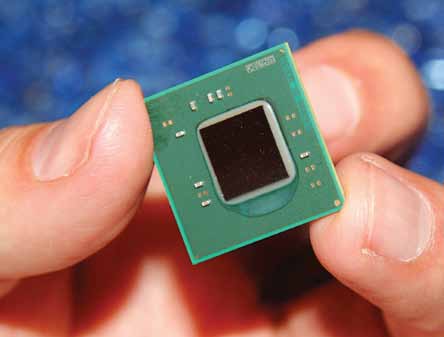
According to Anderson, Intel’s Atom seems to be moving in the right direction, but it’s a long way before it can come close to touching the power efficiency or MIPs/watt ratio found in many ARM variants. There are also cooling issues associated with x86, as for embedded systems developers prefer the processor which does not require external cooling.
Standardisation and integration. Another advantage of x86 architecture is that the standard commercial software is often designed to run on x86-based CPUs. This is also true for many plug-and-play gadgets like printers, keyboards and monitors.
Trivedi shares, “x86 scores over other platforms when the application is very specific and tightly integrated wit legacy counterpart.” If you are looking for easy integration and a wide range of peripherals like lots of GPIO, PCI, UART, analogue-to-digital and digital-to-analogue converters, and storage, the x86 solution is a good choice.
Also, x86 architecture is highly scalable. That means if you have designed an embedded system based on a small x86 processor like an Atom, you can easily replace it with a more powerful processor like Core Duo without much of redevelopment.
Since every processor in the ARM family is individually developed with specific features, it cannot be scaled down or up. For an ARM-based solution, you need to know the exact need of the embedded solution.
Coming to a real-time embedded application, there is hardly any instance when you have to upgrade just the processor of the application. By its very definiion, embedded applications are developed to perform dedicated tasks.
Booting x86-based system. x86 usually comes with basic input/output system (BIOS). Leonid Rosenboim, an embedded systems entrepreneur, says, “BIOS is very useful for booting, but it is the software that you do not control, and may need to change when it is undesirable. This could prevent you from having full control over some resources. Some types of BIOS could actually continue to run in the background along with your RTOS and application, causing occasional mysterious deadline slips. “
In x86, the BIOS can be replaced with a less expensive, lighter-weight and much faster set of boot code like coreboot.
Steve Goodrich, principal, Sage Electronic Engineering, explains, “You wouldn’t use coreboot in every case where you need a BIOS. A BIOS is typically more flexible and intended to work with systems on which the hardware can vary from one boot to another, while coreboot is targeted at systems on which the hardware does not vary, such as an embedded device.”
Commercial-off-the-shelf (COTS) board. Software development on x86 platforms has been quite convenient. However, “The complexity of hardware design and competition from Taiwan prohibits designing of the hardware locally,” shares Sinha. He explains that since x86 platforms have been very popular in digital signage, industrial and other such applications, Taiwanese are offering these products at a very low cost. For example, you can buy a complete motherboard for less than Rs 4000. However, if you have to build it locally, you won’t be able to match the price-point. They have a very good infrastructure to lower the costs.
Adding to the advantages of COTS x86-boards, Sharma shares, “These are extremely useful when you have to deliver a system in a short period and the hardware cycles are unacceptable, volumes are low and the non-recurring cost of development cannot be offset.” He also feels that time-to-market pressures obviate the need for x86 in such a situation.
The disadvantage of COTS boards is their short life of 3-6 months causing you to retest your solutions every time you try a new board. Rosenboimshares, “Most often, an x86 board is chosen for its low cost and low volume, but it also has a short product life, forcing you to replace discontinued boards with new ones that cause unplanned and non-budgeted re-engineering costs and associated risks.”
Applications for x-86
For PC-like performance and high computing capabilities without bothering much about the power efficiency, system developers would prefer to have the x86-based solutions. Industrial motherboards used in automation and other applications that are expected to run a heavy operating system like Windows use x86-based platform.
Sharma shares, “When the list of peripherals that the user is looking for in the system is large, and he wants to avoid the cost of developing all those device drivers, he prefers to use an x86-based solution in order to leverage the already existing set of device drivers and peripherals.” However, a generic x86 is usually lesser-equipped and more expensive than other options available in the market.
The collection of peripherals gives a personality to the chip. “Today, processors are coming as system-on-chip with a large number of peripherals built into the die, giving a much cheaper, more appropriate alternative to the final product,” says Sharma.
Test and measurement equipment. Test and measurement equipment are highly complex embedded systems. These demand precision and accuracy, which is mostly real-time. There are a number of oscilloscopes using x86, as they have an inbuilt Windows XP operating system running beneath.
“x86 architecture-based Atom is also used in data-acquisition products. This is because readymade original equipment manufacturer (OEM) boards are easily available which meet the performance requirements,” Sinha shares.
Networking and communication. Networking and communication is a matured and standardised application area. There are standards and protocols which are universally accepted. This standardisation has given a boost to the use of COTS boards with such peripherals inbuilt. The tedious job of writing device drivers, booting and configurationis already taken care of in such applications.
Automotive electronics. Automotive electronics is a specialised application requiring low power consumption, high effiiency and strong vehicle network communication capabilities.
Rajesh Pathak, senior technology specialist, Delphi Electronics, says, “There are lots of customised microcontrollers available from various vendors which are designed to cater to the needs of the automotive world.”
Expressing his thoughts on x86 platforms, Pathak shares, “Though x86 has a very high processing speed (greater than 3 GHz) and a 64-bit variant, it has not found its place in embedded automotive products. For automotive applications, we use a microcontroller with clock speed of 40-256 MHz but it is so specialised for the application that automotive timing needs are not compromised.”
For automotive applications, mostly 8-/16-/32-bit reduced instruction set computing (RISC) processors/microcontrollers are used. Pathak says, “There are customised microcontrollers available from various vendors for different electronic control units like engine controller, body controller, safety controller and instrumentation controller.” Also, a wide range of development tools are available to allow comfortable product development using these microcontrollers.
Safety-critical applications. You might have experienced the blue-screen-of-death (BSOD) in some signages, kiosks or vending machines. This could be because of power issues or bad software.
Eric Verhulst, CTO, Altreonic, explains, “x86 might work for soft real-time applications, GUIs, etc, where there is ample margin. But for a safety-critical application, it is probably the last choice. It is necessary to keep in mind that when running on a PC, there are tens of dependencies on third-party software, like drivers. Some drivers, even when proprietary and fully approved, are erroneous.”
He shares one experience: “I remember a case where the driver was leaking one byte on every access. In another case, a driver was locking the bus for 10 µs and it was hard to figureout which driver it was.”
Real-time embedded system: does x86 have a place?
Many real-time embedded developers believe that x86 was never meant for embedded applications. It was only meant for desktop and PC-based applications. However, the re-entry of Intel with its Atom clearly hints that Intel never wanted to give away the space. Another thing that embedded developers have strongly realised is that x86 is a good choice for a familiar interface such as Windows operating system.
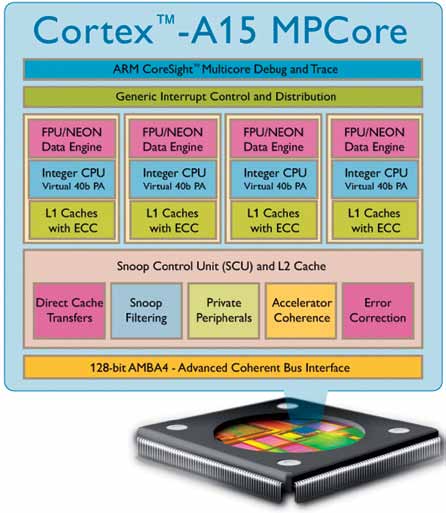
The fight for performance and power between x86 and ARM has picked up and both are trying to address their weaker areas. The x86 was a preferred architecture for the kind of performance it offered until ARM announced Cortex-A15. The release of Cortex-A15 MPCore is going to have a lot of people re-evaluate their decision based on performance. Some of its astonishing features are 2.5GHz speed, multiple cores, fully cache coherent bus protocol for multisocket systems and support for virtualisation, which is not present even in Intel’s Atom processor.
Evaluating the choices for a variety of real-time embedded applications development, ARM leads way over x86. ARM delivers compelling cost-performance and energy-performance ratios. It is a matured architecture licenced by a variety of vendors and the price-competition between them keeps ARM very cost-effective. It has a great support ecosystem of varied users, Open Source tools and numerous vendors. But you never know when Intel pulls out of the bag some new version of Atom!