



As AI accelerators pack more power into less space, a silent electromagnetic war is breaking out inside the rack.
Walk into a modern AI data centre and the first thing you notice is the sound, a relentless wall of cooling fans fighting to keep pace with ever-rising heat loads. The second thing you notice, if you are an RF engineer, is something operators seldom discuss publicly: the electromagnetic noise floor is exceptionally high and climbing.
Driven by the insatiable demands of large language models and computer vision workloads, the rapid densification of AI compute has created a challenge that spans power electronics, RF engineering, and computer architecture. Yet responsibility remains divided across these disciplines, slowing efforts to tackle the issue at the speed it demands.
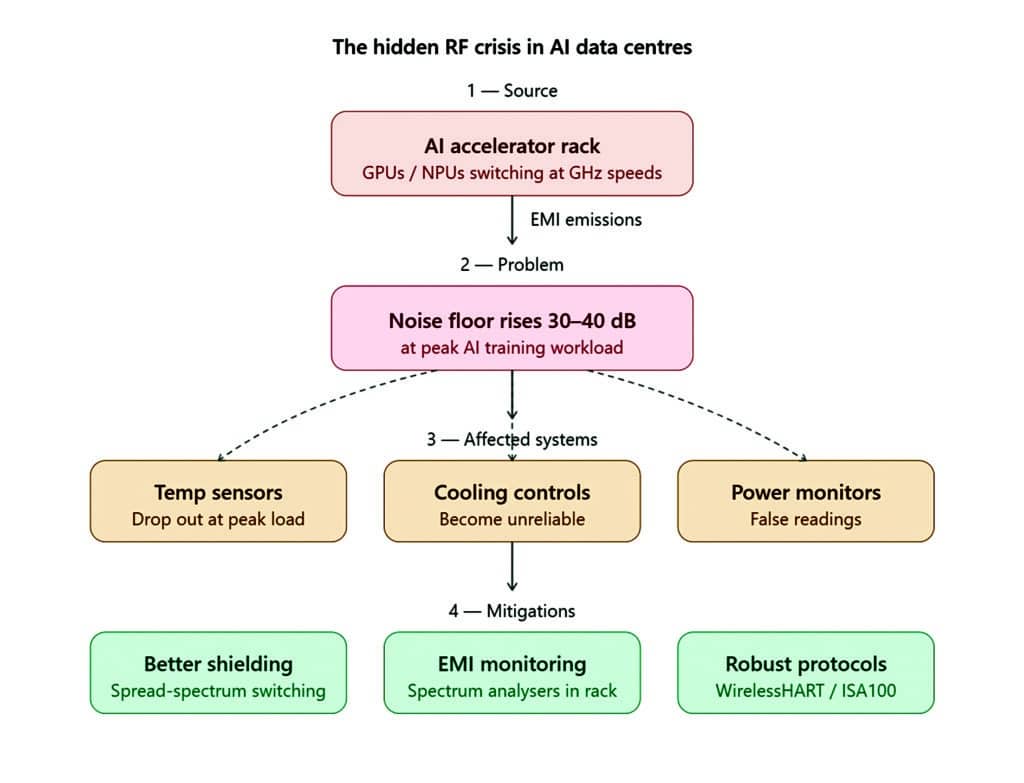
Where the interference comes from

Modern AI accelerators, GPUs, TPUs, and the increasingly common custom NPUs, operate at clock frequencies extending well into the gigahertz range. Their power delivery networks switch at high frequencies to manage the dynamic current demands of massively parallel computation. Each switching event is, from an electromagnetic perspective, a broadcast. The harmonics of these switching events extend across a wide spectrum, overlapping with frequencies used by in-rack wireless sensors, management interfaces, and, in some newer facilities, wireless intra-rack communication links.
The problem compounds as rack density increases. A single high-density AI server might contain eight or more accelerator cards, each with its own power delivery system and generating its own EMI profile. Multiply this across a rack of ten such servers, then across a row of twenty racks, and the result is an electromagnetic environment that resembles a poorly managed radio spectrum in a crowded city.
Shielding, which was adequate in previous generations of compute infrastructure, is struggling to keep pace. Traditional server chassis were designed around the EMC requirements of their era. The field strengths now generated inside dense AI racks exceed what those designs anticipated, and the frequencies involved are sufficiently high that even small gaps in shielding, ventilation slots, cable cut-outs, and connector openings begin to act as antennas.
The wireless sensor problem


