




The isolated USB to UART converter elevates your embedded system’s safety and efficiency, especially in high-voltage and noise-sensitive applications.
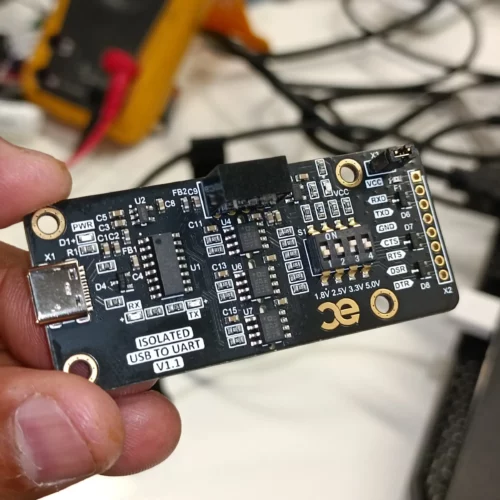
In embedded systems, UART/serial ports are primarily utilized for viewing debug messages, flashing programs, or configuring devices through a command/response protocol. The Industrial Grade Isolated USB to UART converter from CAPUF embedded offers significant benefits across several applications. It is especially useful for companies and engineers who work with power electronics products or manage boards involving high-voltage DC or AC signals. Using this converter ensures safe connectivity to a laptop or PC, preventing potential damage to USB ports or computers from high voltage AC or DC connections. Additionally, non-isolated USB to UART converters often generate leakage currents and can substantially raise noise levels, making isolation a critical feature for maintaining system integrity and performance.
For low-power embedded designs that require 2.5V or 1.8V, such as battery-powered asset trackers, wearables, or other battery-operated devices with UART at lower voltage levels, a specialized USB-to-UART converter is essential. The Isolated USB to UART Converter is particularly useful here, as it includes a voltage selection feature (1.8/2.5/3.3/5.0V), accommodating these specific needs.
In the realm of medical electronics or noise-sensitive circuits, where safety and induced noise are major concerns, an isolated USB to UART converter offers a vital solution. It ensures that embedded boards or products can be safely connected to a laptop or PC without risking interference or damage.
The Isolated USB to UART Converter stands out with several distinctive features. Designed and manufactured in India, the board incorporates a 4-channel DIP switch, allowing easy selection of voltage levels (1.8V, 2.5V, 3.3V, 5.0V). It goes beyond just RX and TX by including additional connections such as RTS, CTS, DSR, and DTR. The board is capable of supplying approximately 100mA of power, which facilitates simple setup during testing of boards that require minimal power. Moreover, it provides Galvanic isolation, ensuring that both power and IOs are isolated, enhancing the safety and integrity of your connections.
For more information, click here.
