




The audio amplifier design combines Class D efficiency with traditional Class AB form factors, enhancing sound in automotive and consumer electronics.
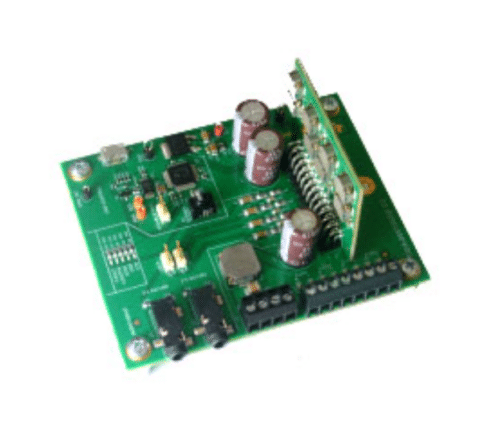
Audio amplifiers are crucial for enhancing sound quality and volume in various applications, from consumer electronics to automotive systems. They play a vital role in delivering clear, powerful audio output that meets the demands of modern listening experiences. The TIDA-00573 reference design from Texas Instruments (TI) offers a Class D amplifier solution in a form factor similar to that of a typical Class AB amplifier, facilitating easy evaluation. It is optimized to reduce the thermal issues common with audio amplifiers and minimize the switching noises characteristic of Class D amplifiers. This design consists of two main components: the first focuses on the audio amplifier module, while the second details the necessary circuitry to integrate it into a base board. Together, these boards enable stand-alone performance testing of the design.
The featured applications of the design include automotive color media or display audio, mid- and low-range head units, and automotive seat vibration audio amplifier modules. These applications are essential for enhancing the multimedia experience in vehicles, offering improved audio and display capabilities for both entertainment and driver interface systems.
The reference design features a size and space-optimized configuration that is robust enough to withstand load-dump conditions and Start/Stop operations down to 5.6 volts. Additionally, it has been tested for electromagnetic interference according to CISPR-25 standards, ensuring its reliability and performance in demanding environments.
The system is designed to serve as a form, fit, and functional evaluation platform, mirroring the typical configuration of Class AB amplifiers integrated within an amplifier head unit. To fulfill this objective, several key design elements have been incorporated. The system supports a vertical profile for the audio amplifier, which allows it to utilize the metal housing of an existing head unit as a heat sink. It includes off-battery voltage support with line noise filters that draw power from a reverse battery protection circuit off the baseboard. Additionally, the design integrates a speaker drive filter to prevent noise coupling into the AM radio band.
To facilitate the integration of this module into a head unit base board, a companion board is provided. This board showcases crucial components such as decoupling capacitors and analog input noise filters, along with layout considerations essential for incorporating the module effectively into the overall design.
In a Class D amplifier, an audio signal modulates the PWM (Pulse Width Modulation) output, leading to an output that combines the audio band with the switching frequency. To effectively filter out the PWM switching frequency, a low-pass filter is used at the output. The filter in this design has a cutoff frequency set below the switching frequency to ensure clean audio reproduction by removing high-frequency noise.
TI has tested this reference design. It comes with a Bill of Material (BOM), schematics, Gerber file, etc. You can find additional data about the reference design on the company’s website. To read more about this reference design, click here.

