

Stanford researchers use background electrical noise as a signal to transmit data with up to 1,000 times less energy.
Wireless communication typically requires a transmitter to generate and amplify radio signals, consuming energy that can be a significant burden for battery-powered sensors. Researchers at Stanford University have demonstrated an alternative that encodes data by controlling how a circuit reflects naturally occurring electrical noise, potentially enabling ultra-low-power communication for devices that transmit only small amounts of information.
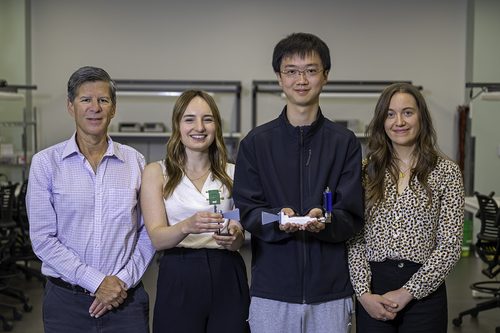
The research, led by assistant professor Zerina Kapetanovic, with graduate students Geneva Ecola and Jida Zhang and professor Joseph Kahn, was published in the Proceedings of the National Academy of Sciences (PNAS). The approach uses thermal noise, a random electrical signal produced by the thermal motion of charge carriers in conductors, as the source of the signal being reflected.
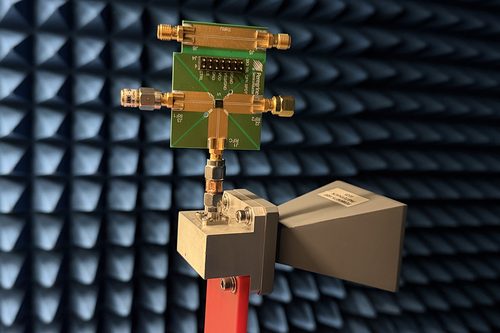
The transmitter encodes binary data by switching between open-circuit and short-circuit states. These states change how incoming thermal noise is reflected, allowing a receiver to distinguish between them and recover the transmitted information. Rather than generating its own radio-frequency carrier, the transmitter modulates an existing noise source. The receiver uses amplification and signal processing to identify the resulting differences in the received noise.
The principle resembles backscatter communication, in which a device transmits information by changing how it reflects an existing signal. However, conventional backscatter systems typically rely on an external radio-frequency source, whereas this technique uses naturally occurring thermal noise. The researchers describe the transmitter as a reflector rather than an active radio source.
According to the team, the approach could consume up to 1,000 times less energy for transmitting information than a conventional radio-frequency transmitter. The researchers also developed a mathematical channel model and a transmission scheme that increased the demonstrated data rate by 100 times compared with their earlier setup. These figures describe the researchers’ reported results; practical performance will depend on the operating environment, receiver design and communication requirements.
The technique is intended for applications that need to transmit small quantities of data rather than continuous high-bandwidth streams. Examples include sensors reporting soil moisture or environmental conditions, identification tags and devices operating near sensitive equipment. Conventional Bluetooth and Wi-Fi radios are designed to support more demanding communication tasks, but their power requirements can be unnecessary for sensors that only need to send occasional measurements.
The demonstration remains at the laboratory stage. The researchers conducted their experiments in a shielded environment to prevent external radio signals from interfering with the measurements. Operation in ordinary indoor and outdoor environments, where competing noise sources may affect reception, remains to be established. The team also needs to investigate how multiple transmitters could operate together in a practical network.
For India, the technique could eventually be relevant to agricultural monitoring, environmental sensing and other distributed systems in which replacing batteries across large numbers of remote devices is expensive. However, it is too early to conclude that the method will eliminate battery replacements or work reliably across large sensor networks. Further testing outside controlled laboratory conditions is needed before its suitability for field deployment can be assessed.
For more information, click here.