
Devices often waste the light around them. A chip helps hybrid solar cells turn any light, indoors or outdoors, into power, keeping devices running longer.
Many portable and stationary devices struggle to make the most of available light for power, especially when lighting conditions vary widely, from dim indoor environments to bright outdoor sunlight. Traditional photovoltaic cells often fall short, generating too little energy indoors or lacking efficiency across different conditions.
Hybrid photovoltaic cells can address this gap by harvesting energy over a much wider range, from microwatts under indoor lighting to several watts in direct sunlight. But managing this wide dynamic range efficiently has been a challenge for device designers, particularly when pairing PV cells with batteries or lithium-ion capacitors.
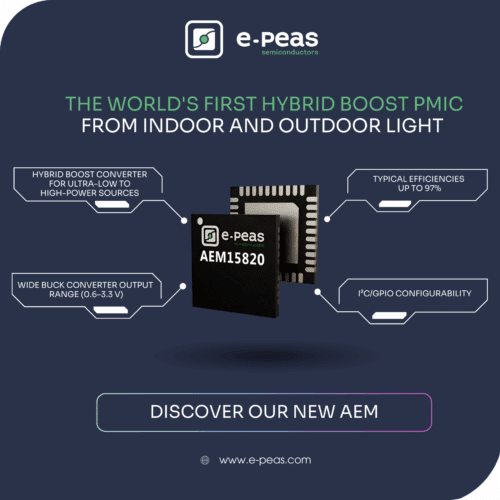
The AEM15820 from e-peas solves this problem. This single-chip energy harvesting PMIC can handle the full output range of hybrid PV cells, automatically switching between low and high power boost converters to maintain efficiency. It supports configurable voltage regulation, storage protection, thermal control, and load output, making it flexible for different device requirements.
This technology enables hybrid PV cells to power a broad set of devices that need reliable energy from light, including self-charging headphones, e-readers, sports and hiking computers, remote security cameras, smart glasses, power banks, and smart backpacks. It also allows fast charging from mains with a 5 V DC input.
With an ultra-low-power cold start of 5 µW at 275 mV and an output range of 0.6 to 3.3 V up to 100 mA, the AEM15820 makes it practical for designers to integrate hybrid PV energy harvesting into a wide range of consumer and professional devices.
“The AEM15820 is the first single-chip PMIC that truly spans the full dynamic range of hybrid cells, from microwatts to watts, making continuous charging of consumer devices practical at scale, covering both indoor and outdoor environments,” said Geoffroy Gosset, CEO & Co-founder at e-peas. “This breakthrough doesn’t just improve existing designs, it creates new categories of self-powered products. From smart consumer gear to outdoor electronics and emerging lifestyle devices, the number of applications now within reach expands dramatically.”