

A compact VPX computing board combines GPU acceleration, high-speed memory and rugged thermal options for demanding embedded workloads at the edge.
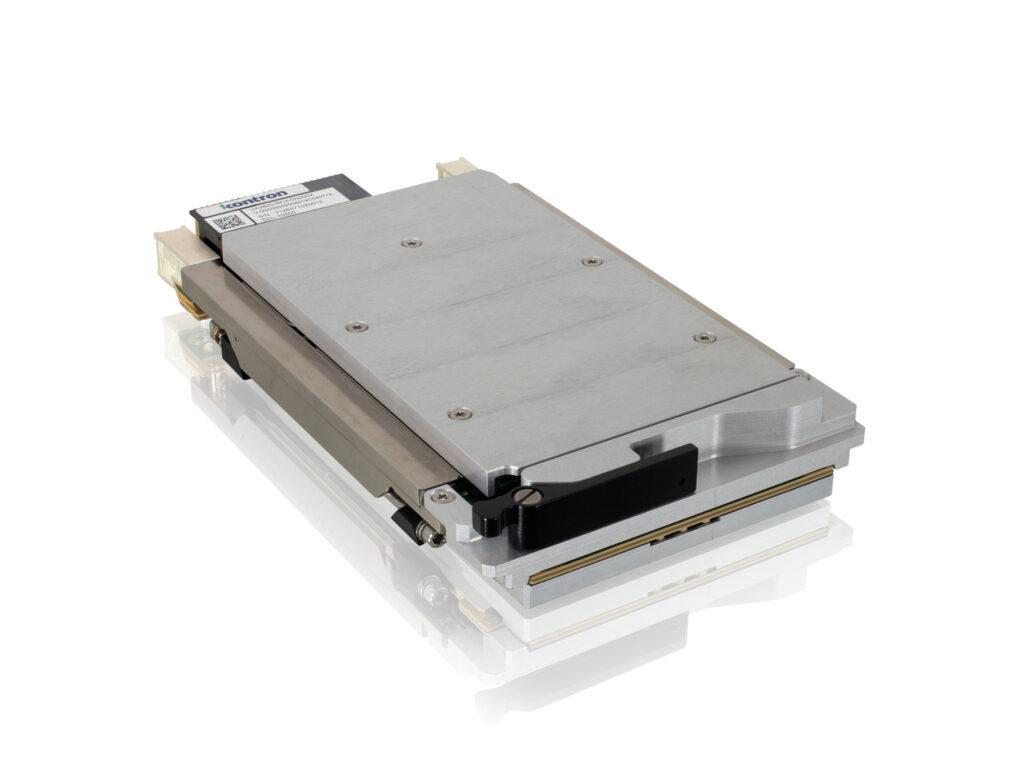
High-performance AI and graphics processing can be difficult to deploy in embedded systems where computing density, environmental resilience and system interoperability are critical. The VX33211, a 3U VPX GPU board from Kontron, addresses these requirements by integrating an NVIDIA RTX PRO 2000 Blackwell Embedded GPU for AI inference, advanced graphics, sensor processing and general-purpose GPU acceleration. The board delivers up to 13.78 TFLOPS of FP32 performance while fitting into a single-slot 3U VPX architecture.
The key features are:
- NVIDIA RTX PRO 2000 Blackwell Embedded GPU
- 60 W total graphics power
- Base/boost clock: 1,522/2,070 MHz
- DirectX 12 Ultimate, OpenGL 4.6 and Vulkan 1.2
- Two DisplayPort 1.4 outputs on air-cooled version
At the heart of the VX33211 are 3,328 CUDA cores, 104 Tensor Cores, and 26 RT Cores. The combination allows the board to handle parallel computing workloads while accelerating AI inference, deep-learning operations, and real-time graphics. It includes 8 GB of GDDR7 memory with a 128-bit interface and bandwidth of up to 384 GB/s, supporting high-throughput processing of data-intensive workloads.
The board is designed for rugged embedded platforms, with a conduction-cooled version supporting an operating temperature range of -40°C to +85°C at the card edge. An air-cooled variant is available for laboratory evaluation and testing. The conduction-cooled configuration uses VITA 48-style mechanics, making the platform suitable for systems where thermal management and mechanical robustness are important.
For system integration, the VX33211 follows SOSA-aligned OpenVPX profiles, supporting an open architecture approach intended to improve interoperability and reduce integration effort. PCIe Gen4 connectivity is provided through the backplane, with an x8 PCIe interface and an expansion plane supporting up to x4 PCIe Gen4. An IPMI controller provides VITA 46.11 Tier 3 support and out-of-band system management.
The GPU board is suited to workloads such as AI-assisted image processing, sensor-data analysis, mission computing, radar and sonar processing, electronic-warfare signal processing, and embedded training and simulation. For electro-optical/infrared systems, its parallel-processing resources can support real-time image enhancement and AI-based data analysis, while graphics capabilities can assist visualization and simulation workloads.
Click here for the original announcement.