




What if your railway power system could handle voltage drops, heat, and shocks without stopping? Learn about the solution that keeps trains running.
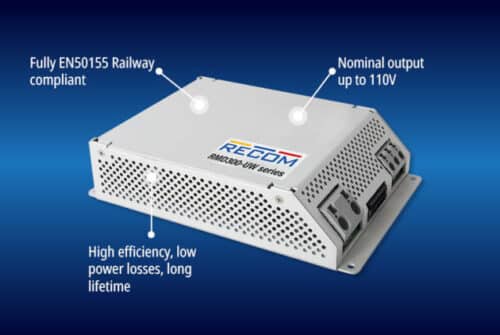
Railway operators and engineers need reliable, compact power solutions that handle wide voltage variations, extreme temperatures, and harsh operating conditions. RECOM’s new RMD300-110-110SUW 300 W DC/DC converter addresses these challenges by providing a fully regulated 110 VDC output across an ultra-wide input range of 16.8 V to 137.5 V. This means it can adapt to virtually all rail systems worldwide and tolerate sudden voltage dips or surges, keeping critical onboard systems running without interruption.
The converter is built for tough environments. It can operate continuously up to 85 °C without losing performance and temporarily boost power to 330 W when needed. Its rugged design meets stringent railway standards for shock, vibration, fire safety, insulation, and electromagnetic compatibility, ensuring reliability over a 20-year design life even in Class OT4 and extended ST1/ST2 conditions.
Safety and resilience are built in: the unit protects against reverse polarity, under-voltage, over-temperature, short circuit, and over-current, while parallel operation is possible for redundancy or higher power needs. Control and monitoring features like remote ON/OFF, output trim, current sharing, and a Power OK signal simplify system integration and maintenance.
Despite its capabilities, the RMD300-110-110SUW comes in a compact open-frame package with screw terminal connections, making it suitable for space-limited applications. Its reinforced isolation, high MTBF, and compliance with environmental and electrical standards make it a reliable choice for engineers seeking robust, long-lasting power for modern railway systems.
“Our RMD300 range now includes 110VDC output which is ideal for powering downstream railway equipment that has a limited input range” comments Marco Kuhn, product manager DC/DC Plug & Play of RECOM. “The DC/DC is fully compliant with rail specifications without need for external components”.


