As megawatt level charging enters electric mobility, a revised battery architecture explores how vehicles could move from low charge to near full capacity within minutes.
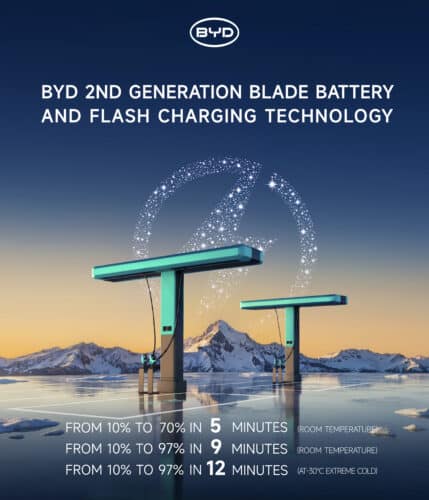
BYD has unveiled the second generation Blade Battery alongside FLASH charging technology, developments aimed at addressing two persistent challenges in electric mobility: charging speed and low temperature charging performance.
Electric vehicle adoption continues to grow globally, yet concerns such as range anxiety, long queues at charging stations during peak travel periods, and slower charging performance in cold climates remain significant considerations for users. Improving charging efficiency and expanding infrastructure have therefore become key areas of focus across the electric vehicle industry.
The second generation Blade Battery is designed to significantly reduce charging time. Vehicles equipped with the battery can charge from 10 percent to 70 percent state of charge in about five minutes, while reaching almost 97 percent in nine minutes. Even under extremely low temperatures of around minus thirty degrees Celsius, charging from 20 percent to 97 percent requires only about three additional minutes compared with room temperature conditions.
Development of the battery platform followed six years of research and engineering work. Battery design has traditionally faced a tradeoff between fast charging capability and high energy density. The updated Blade Battery increases energy density by about five percent compared with the previous generation while enabling faster charging performance.

To manage heat generation during rapid charging, the architecture incorporates a lithium ion high speed channel and a full spectrum intelligent thermal management system. These elements are designed to reduce internal heat buildup and support stable operation during high power charging cycles. The battery will be deployed in the DENZA Z9GT, where it is paired with a lightweight vehicle body structure that enables an estimated driving range of 1,036 kilometers.
Alongside the battery platform, FLASH charging infrastructure was introduced with a single connector output of up to 1500 kilowatts. The charging system is designed to operate alongside high capacity energy storage units, allowing ultra fast charging while reducing strain on local power grids. Charging stations using the system feature a T-shaped pulley based connector design with a zero gravity cable mechanism that allows users to maneuver the connector easily while keeping cables elevated and off the ground.