


See how wearable devices monitor heart rate, oxygen levels, respiration, and other vital signs with ease. These designs help engineers develop smart health devices faster and more efficiently.
Wearable devices can now track vital signs such as heart rate, oxygen levels, respiration, and body temperature. Chest patches, wristbands, and heart monitors integrate sensors, processing, and wireless connectivity in a single system. Following ready-to-use reference designs helps engineers build health and fitness devices faster and more easily for home monitoring, exercise tracking, and remote patient care.
Chest-worn patch
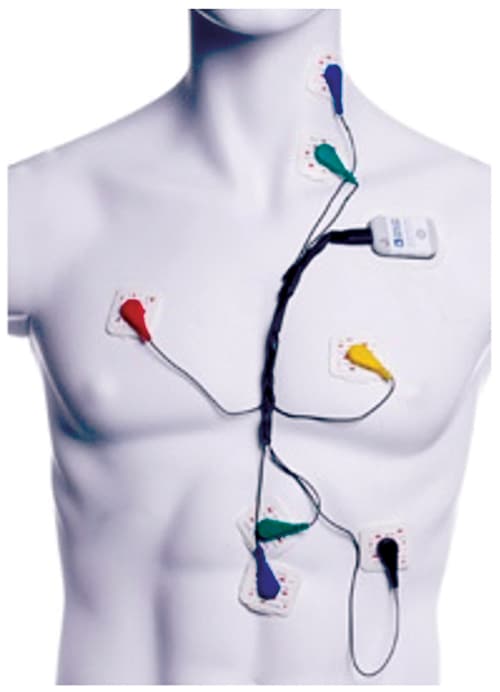
This reference design enables monitoring of vital signs using a chest-worn patch that integrates PPG, ECG, BioZ, and temperature sensors. It measures SpO2, heart rate, respiration, cardiac output, body impedance, and skin and ambient temperatures, then streams the data via Bluetooth Low Energy (BLE) to a PC GUI for viewing, logging, and custom development.
The patch operates for a full day on a single charge. The PPG system uses red and infrared LEDs with dual photodiode receivers, while ECG and BioZ measurements use three or four electrodes. By combining sensing, signal processing, wireless streaming, and a ready-to-use GUI, the design reduces setup effort, additional circuitry, and integration effort for engineers and researchers developing wearable health monitoring systems.
Applications: The reference design is suitable for fitness and health applications.
OEM Brand: Analog Devices (ADI)
See more details about the Health Sensor Platform 4.0 Reference Design.
Fitness tracker
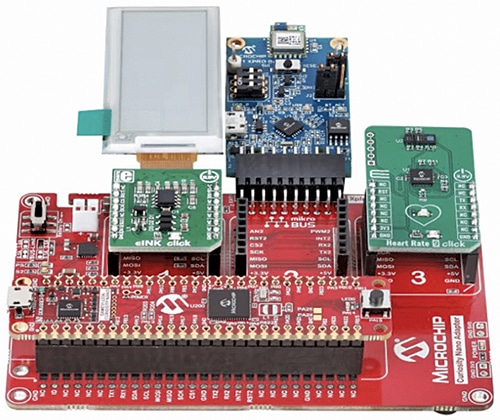
This reference design supports the development of fitness trackers with real-time heart rate monitoring, low-power displays, and wireless connectivity without requiring engineers to design the entire system from scratch.
It integrates a 32-bit microcontroller with sensors, an e-ink display, and optional Bluetooth Low Energy (BLE) to collect, display, and transmit biometric data. The design supports multiple microcontroller variants, allowing engineers to select either high-performance or ultra-low-power configurations.
Heart rate is measured using a finger-based optical sensor, while the low-power e-ink display displays readings with minimal energy. In BLE configurations, data can be transmitted to a mobile application for logging or analysis. By combining signal acquisition, processing, display, and wireless communication in a modular platform, the reference design saves development time and reduces integration effort.
Applications: The reference design allows reuse across fitness bands, smartwatches, or medical monitors.
OEM Brand: Microchip Technology
See more details about the Low-Power Fitness Tracker Wearables Reference Design.
Health monitor band