





A sensing platform combines 3D perception, AI processing, and depth imaging to support vehicles, robotics, and machine vision applications.
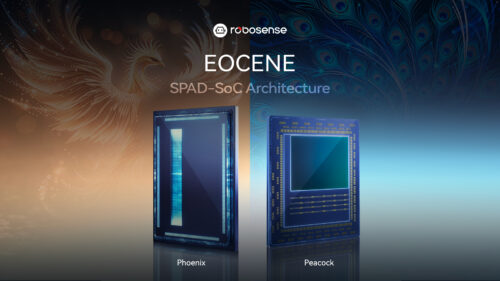
RoboSense has introduced a new integrated hardware and AI system built around its self-developed SPAD-SoC architecture, EOCENE, alongside two image-grade chipsets, Phoenix and Peacock, and previewed an RGBD sensor slated for launch in 2027. Together, the technologies are designed to accelerate the transition toward high-resolution 3D perception across autonomous driving, robotics, and AI-powered machines.
At the core of the announcement is EOCENE, RoboSense’s SPAD-SoC platform, which consolidates nearly a decade of LiDAR research into a unified architecture intended for scalable deployment. The platform is built on a 28nm automotive-grade process and incorporates third-generation SPAD technology with 45% photon detection efficiency, along with second-generation 3D stacking through wafer-level hybrid bonding.
EOCENE also includes a configurable 4,320-core heterogeneous computing array and a high-bandwidth network-on-chip capable of processing up to 495 billion point-cloud samplings per second. RoboSense says the platform supports ultra-HD perception at near-thousand-beam densities while integrating hardware-based anti-interference and signal-processing engines that achieve up to 99.9% sunlight noise suppression and 99.9% crosstalk immunity. The architecture is designed to operate in automotive environments ranging from -40°C to 125°C.
The Phoenix configuration delivers a 2160 × 1900 resolution, generating both point-cloud data and 2K near-infrared imaging. RoboSense says the system supports detection ranges of up to 600 meters and meets AEC-Q100 automotive qualification standards. The company added that Phoenix-based systems have already secured design wins with global automakers, with mass production planned for 2026.

Alongside Phoenix, RoboSense unveiled Peacock, an all-solid-state large-array SPAD-SoC developed for robotics and machine perception applications. Peacock integrates a 640 × 480 sensing array into a single chip, enabling VGA-level image output instead of sparse point-cloud generation.
The chipset provides a 180° × 135° field of view and millimeter-level accuracy at distances as close as five centimeters. RoboSense says Peacock is designed for use across blind-spot detection, low-speed autonomous mobility, industrial safety systems, robotics, and other sensing applications. Mass production is scheduled for the third quarter of 2026, with initial customer deliveries already underway.
Building on Peacock’s sensing architecture, RoboSense also previewed an RGBD sensor that combines color and depth perception by integrating a color filter array directly into the chipset. The system is intended to fuse RGB imaging with high-density 3D spatial data to create environmental perception capabilities.
Click here for the original announcement.


