


In electronics manufacturing, even a perfect prototype can fail without a robust Bill of Materials. Smart BoM optimisation, disciplined design-for-manufacturing, and close attention to often-overlooked assembly details can turn fragile plans into market-ready successes.
This article is based on a tech talk session at IEW 2025 in Bengaluru by Srinivas Parikshith, CEO, Auckam Technologies. It was transcribed and curated by Akanksha Sondhi Gaur, Sr Technical Journalist at EFY.
Success in electronics manufacturing is not defined solely by a flawless schematic or a working prototype. It depends on the resilience of every stage of the process. The Bill of Materials (BoM) may appear to be a dry inventory list, but it is the heartbeat of production. A single overlooked component can derail a product launch, erase months of work, and drain budgets faster than a reflow oven at peak load. Supply chain volatility, moisture sensitivity, compliance pitfalls, and subtle PCB assembly details—such as fiducials and apertures—can quietly determine whether a product succeeds or fails.
At times, a BoM is merely a cost list. At others, it becomes a ticking time BoMb waiting to explode at the worst possible moment.
Consider a common scenario. A promising IoT product is ready. The prototype works flawlessly, performance meets expectations, and the first small batch ships without a single hiccup. Everything appears perfect. Then the twist appears.
Hidden in the BoM is a small off-the-shelf, no-brand switch—picked up online with little scrutiny. When a 10,000-piece order arrives, sourcing that exact switch becomes impossible. The supplier has vanished. The closest available alternative carries an eight-month lead time.
The only option is a redesign. By the time the redesign is completed and sourcing stabilises, the order is gone. The result: a ₹2.2 million loss—triggered by a single overlooked component.
The four pillars of BoM optimisation
BoM optimisation is far more than a procurement exercise. It combines risk management, quality assurance, and long-term product strategy. A single overlooked component can derail months of work and cost millions. In practice, BoM optimisation is not just about cost control—it is about product survivability. Some tips:
- Financial: Reduce product cost without compromising quality
- Compliance: Ensure components meet required standards such as RoHS, lead-free, medical, defence, and export certifications
- Technical: Monitor end-of-life parts, shelf-life issues, and NRND (Not Recommended for New Design) components
- Manufacturability: Avoid parts that are difficult or expensive to assemble
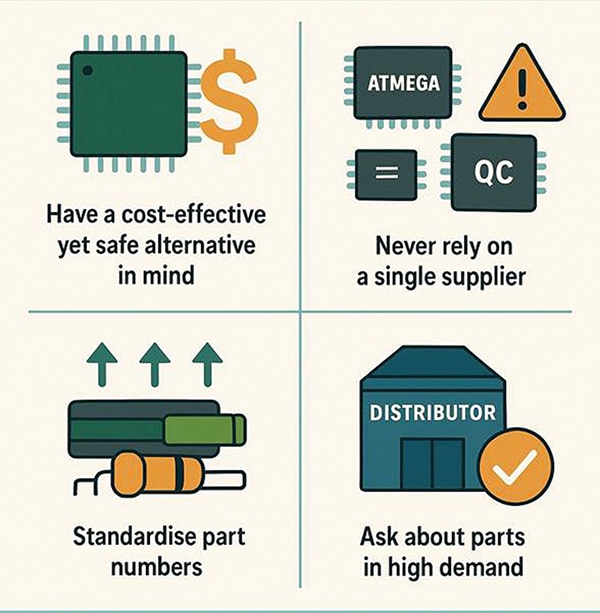
Let’s break those down. When sourcing components, always keep a cost-effective and reliable alternative in mind. High-volume microcontrollers such as the ATmega2560 are more likely to appear in grey markets, where counterfeit, remarked, or QC-rejected parts can circulate through secondary channels; so buying outside authorised channels is a gamble. Never rely on a single supplier—having two or even three can save you from this kind of supply nightmare. If you are developing multiple products, standardise part numbers for common components such as resistors, capacitors, and microcontrollers; this not only boosts order volumes and improves pricing but also simplifies sourcing.
It is worth asking your distributor which parts are in high demand among their other big customers—you might get bulk pricing benefits without committing to massive purchases yourself. Always respect component lifecycles by checking manufacturer websites for end-of-life or NRND status, rather than relying solely on distributor listings. Shelf life varies by component type—electrolytic capacitors, for example, have shorter storage limits and can degrade if kept unused for extended periods.
Watch out for moisture sensitivity levels (MSL), which indicate how vulnerable electronic components are to absorbing moisture before soldering. Components in plastic packages can absorb humidity, and during reflow (above ~240°C), this moisture expands rapidly, causing cracks or the ‘popcorn’ effect.
For example, some LEDs are MSL level 5, giving you just 48 hours to assemble them once opened before they require baking; miss that window, and your production line could come to a halt. So the next time you are finalising your BoM, remember: treat it not as a static list, but as a living strategy. Your future self—and your budget—will thank you.
A well-optimised BoM can lower costs, increase product reliability, and provide multiple sourcing options, preventing unpleasant last-minute surprises. The challenge is that BoM optimisation is never a one-time task.
Component prices fluctuate, distributors change, and vendors occasionally disappear.
For cost-sensitive products, reviewing the BoM every three to four months is advisable. For lower-volume or less price-sensitive builds, a review once or twice a year is generally sufficient.
| 6 proven ways to dodge costly electronics design mistakes |
Through trial, error, and many ‘we should have caught that earlier’ moments, several practices have consistently helped avoid pitfalls in PCB manufacturing: • Run regular BoM audits: Check not only cost but compliance and technical performance. • Embrace DFM: Design for manufacturability reviews catch problems early. • Involve both your design partners and manufacturing partners early: Share your schematics and PCB layout with authorised semiconductor distributors of critical parts that you use (such as STM’s authorised partners), as they often provide design reviews to verify correct component selection, reference designs, power layout, and overall circuit implementation. Also, share your PCB files with your assembly partner, who can review for manufacturability (DFM), footprint correctness, panelisation, and assembly constraints. • Keep supplier communication open: A quick discussion now can save weeks of troubleshooting later, and source through authorised distributors. • Check MSL requirements: Identify moisture-sensitive components and define proper storage and baking procedures. To prevent failures, such components must be stored in vacuum-sealed packs or dry cabinets, tracked for exposure time, and baked if limits are exceeded, as defined by IPC J-STD-033. • Add proper fiducials: Include global and local fiducials to ensure accurate automated assembly alignment. In short, catching issues with fiducials and apertures isn’t about luck—it is about building in these habits early. |
Bake, seal, protect