






A small RF device splits and combines signals with less loss, uses less space, and helps systems work better in high frequency applications.
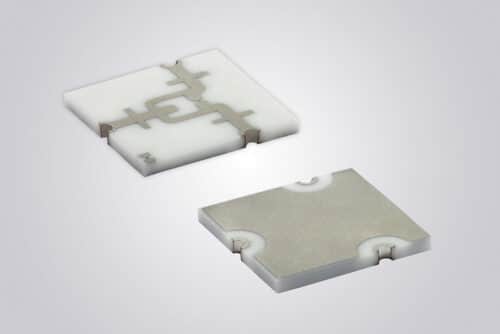
Vishay Intertechnology has introduced a 2-way Wilkinson power divider / combiner built for aerospace, defense, and high-frequency connectivity systems. It operates across 15 GHz to 20 GHz and delivers insertion loss of less than 0.5 dB below 19 GHz, helping reduce power loss and improve overall system efficiency.
The device comes in a compact surface-mount 1817 package that integrates a three-port solution, allowing it to function as both a divider and a combiner. This integration reduces the need for external components, simplifies RF system design, saves board space, and helps lower overall system cost. With a return loss of 10 dB to 15 dB, it supports stable signal transmission across a wide frequency range.
It offers high output-to-output isolation of less than 20 dB at the center frequency. This helps minimize crosstalk, protects downstream amplifiers during signal combining, and maintains stable performance across parallel RF signal paths. The device also maintains strong matching characteristics across the full operating band, supporting consistent RF performance.
Designed for demanding environments, the device operates over a wide temperature range from -55 °C to +155 °C. It can be used in automotive ADAS systems, radio transceivers, LEO satellite systems, base station terminals, 5G and 6G infrastructure, drones, weapons guidance systems, payload systems, data link arrays, and phased-array radar systems.
RF engineers, system designers, and hardware teams can use the WLKN-000 to split signals into multiple paths or combine signals from different sources with minimal loss. This supports the development of compact RF front ends, efficient signal distribution in phased-array systems, protection of amplifiers during signal combining, and stable performance in multi-channel communication and sensing systems.
The device is RoHS-compliant, halogen-free, and aligned with Vishay Green standards. It is built on thin film technology and can be customized based on requirements such as frequency band, return loss, insertion loss, and case size. HFSS-encrypted models are also available for accurate simulation and design integration.
Click here for the original announcement.

