





What powers the electronics behind appliances? Explore an auxiliary power supply design built for standby operation, power conversion, isolation, and system protection.
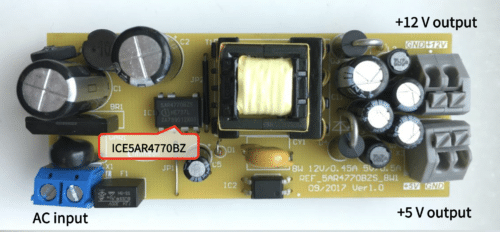
The Infineon Technologies REF_5AR4770BZS_8W1 reference design presents an auxiliary switch-mode power supply (SMPS) for home appliance and HVAC applications, where standby and housekeeping supplies are required. The converter operates from a universal AC input range of 85–265 VAC and provides two isolated DC outputs, 12 V and 5 V, making it suitable for powering control electronics, relays, sensors, and communication interfaces. The design represents an implementation of an offline auxiliary power architecture focused on efficiency, reliability, and regulatory compliance.
The power stage is based on a discontinuous conduction mode (DCM) flyback topology operating around 100 kHz. Flyback remains one of the most used topologies for low-power isolated supplies because of its component count, structure, and ability to provide multiple isolated outputs through a transformer. In this design, the transformer performs isolation and energy storage functions, helping reduce system complexity while maintaining safety requirements. The magnetic design supports operation across the input voltage range while maintaining regulation on both outputs.
A feature of the design is the use of an integrated offline power controller with an internal high-voltage switching device. Integrating the PWM controller, startup circuitry, switching element, and protection functions into one package reduces the external bill of materials (BOM), simplifies PCB routing, and improves system reliability. For design engineers, this integration shortens development time by reducing the number of external design variables.
Efficiency optimization is a focus in this implementation, particularly under light-load and no-load conditions. In appliance applications, standby power consumption is an important specification due to energy regulations. The design incorporates burst-mode operation during light-load conditions, reducing switching losses and lowering standby power. This enables compliance with energy efficiency standards while maintaining wake-up performance when load demand increases.
The input stage includes an electromagnetic interference (EMI) filter, bridge rectifier, and bulk capacitor for energy storage. The EMI filter is designed to meet conducted emission requirements without increasing component cost. To improve EMI performance, frequency jittering is used in the switching control, distributing switching energy over a frequency spectrum and reducing noise levels. This approach helps reduce filter size and improve cost efficiency.
Output regulation is achieved using isolated feedback through an optocoupler, which provides voltage control across line and load conditions. The feedback compensation network is tuned to ensure loop stability while maintaining transient response during load changes. This is important in appliance systems where control circuits may experience changes in current demand.
The design also includes protection mechanisms such as overcurrent protection, overload protection, undervoltage lockout, overvoltage protection, and short-circuit protection with automatic restart. These protections improve system operation and fault tolerance in field applications, reducing service failures caused by operating conditions.
Infineon Technologies has tested this reference design. It comes with a bill of materials (BOM), schematics, assembly drawing, printed circuit board (PCB) layout, and more. The company’s website has additional data about the reference design. To read more about this reference design, click here.
