

New research decoding insect wing dynamics could enable highly stable flapping robots, improving micro-drone control, efficiency, and real-world deployment in complex environments like agriculture, inspection, and rescue missions.
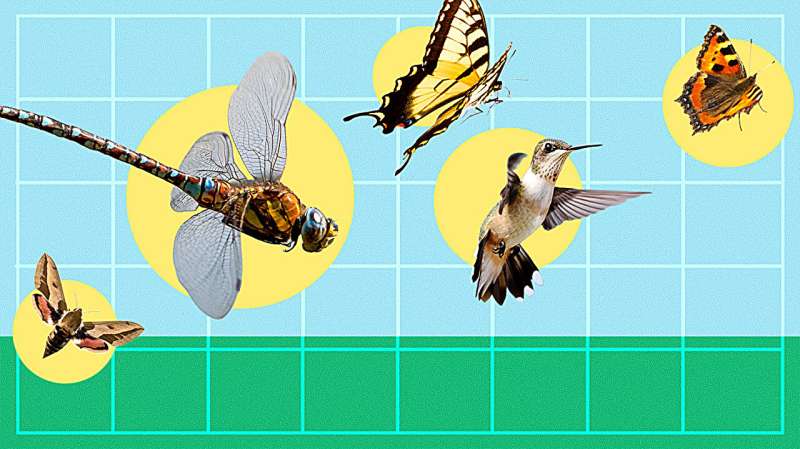
A new study decoding how insects maintain stable flight could pave the way for more reliable flapping-wing robots, addressing a long-standing challenge in aerial robotics.
Researchers at Cornell University have developed a computational model that links insect body structure and wing motion to flight stability. The findings provide a physics-based framework for designing micro air vehicles that mimic insect flight with greater control and efficiency.
Unlike conventional drones that rely on propellers and rigid control systems, insects achieve stability through a complex interaction between wing flapping, body orientation, and aerodynamic forces. These dynamics are difficult to model, especially at small scales where turbulence and rapid wingbeats dominate.
The new model shows that an insect’s morphology—particularly how its mass is distributed and how wings move relative to the body—plays a critical role in passive stability. Instead of relying entirely on active control systems, insects inherently stabilize themselves through their physical design.
This insight could significantly simplify robotic design. Current flapping-wing robots often require complex sensing and control algorithms to remain stable, limiting their efficiency and real-world usability. Embedding stability directly into the robot’s structure could reduce computational load, energy consumption, and system complexity.
The research also helps explain how insects evolved highly efficient flight mechanisms. By understanding these principles, engineers can translate biological strategies into robotic systems that perform better in cluttered or unpredictable environments.
Applications range from search-and-rescue missions in confined spaces to precision agriculture and environmental monitoring—areas where small, agile flying robots have clear advantages over traditional drones.
The work builds on broader efforts in bio-inspired robotics, where insect-scale machines such as RoboBee have already demonstrated controlled flight but still struggle with stability and autonomy.
While the current findings are based on simulations, researchers are now working toward experimental validation. If successful, the approach could mark a shift in aerial robotics—moving from control-heavy systems to designs where stability is engineered directly into the hardware.
As demand grows for compact, energy-efficient flying machines, insect-inspired engineering may offer the blueprint for the next generation of autonomous aerial robots.